Ask a brand executive which layer matters most in a diaper, and they will say the core. That answer is not wrong — but it is incomplete.
In product development conversations, the absorbent core is always the protagonist. Brands invest the most R&D hours, the largest BOM allocation, and the most frequent specification adjustments into this single component. The logic is intuitive — the core absorbs liquid, and absorption is the most fundamental function of a diaper.
But between the core and the topsheet sits a layer that most consumers have never heard of — and that many brand-side product managers cannot accurately describe: the Acquisition Distribution Layer (ADL).
The name itself sounds bureaucratic. But in a recent round of systematic variable-isolation testing, we discovered something that forced the entire team to reassess product architecture: changing only the ADL — while keeping the topsheet and core identical — improved system rewet performance by a greater margin than changing the core itself.
In other words, the ADL’s control over “how dry the product actually feels” — the single metric consumers care about most — is far greater than most brands assume.
What the ADL Does: The Maxwell’s Demon of Diaper Engineering
There is a famous thought experiment in physics called Maxwell’s Demon — a hypothetical gatekeeper sitting at a partition between two chambers, capable of judging the velocity of each molecule and selectively allowing fast molecules through while blocking slow ones. The demon creates an ordered outcome from disorder. It violates the second law of thermodynamics — which is why it can only exist as a thought experiment.
But the ADL performs a strikingly similar function in liquid management — a gatekeeper positioned between the topsheet and the core, conducting precision traffic control on every milliliter of fluid:
Acquisition: Liquid enters the topsheet at a concentrated point. Without horizontal distribution, that single point in the core would saturate instantly while the rest remains completely dry — wasting absorption capacity. The ADL spreads the incoming liquid laterally across a larger surface area before it enters the core.
Distribution: The ADL controls the rate and pattern at which liquid enters the core. Too fast, and the core’s surface lock-up layer does not have time to react. Too slow, and liquid lingers on the topsheet surface — the consumer feels “wet.” The ADL must find this balance in milliseconds.
Anti-Rewet: Liquid already absorbed into the core can be squeezed back out under the pressure of a baby’s body weight. The ADL acts as a one-way valve — making it easy for liquid to travel downward and difficult to travel back up. No ADL achieves the perfect selectivity of Maxwell’s Demon — some liquid always returns — but the gap between an excellent ADL and a mediocre one on this metric is far larger than most people expect.
These three functions operate simultaneously. A single thin layer of nonwoven material carries the entire product’s liquid traffic management responsibility.
The Speed Compensation Effect: A Counterintuitive Finding
We ran a variable-isolation experiment — topsheet and core held constant, only the ADL material swapped. The test protocol used three consecutive liquid insults (simulating three urinations within a single diaper’s wear cycle), measuring topsheet surface rewet after each.
The result was unexpected:
One ADL material reduced third-insult rewet by over 90% — with zero changes to the core.
The third insult is the critical one: by this point, the core has absorbed the load from two prior insults and is approaching saturation. Under these extreme conditions, the ADL’s distribution efficiency determines whether liquid can find unused regions of the core. A high-performing ADL routes liquid to the core’s “unoccupied zones” — genuinely acting as Maxwell’s Demon, sorting fluid to where it is needed most. A mediocre ADL lets liquid pool at the original entry point — then, under pressure, it rewets.
We named this phenomenon Speed Compensation — the ADL’s superior liquid distribution compensates for the core’s declining absorption capacity as it approaches saturation. In essence, a good ADL makes an ordinary core perform like a premium one.
What this means for product strategy: If your core is already adequate but rewet problems persist, the answer may not be a core upgrade. It may be an ADL reassessment.
Four Technical Routes: Not All ADLs Are Equal
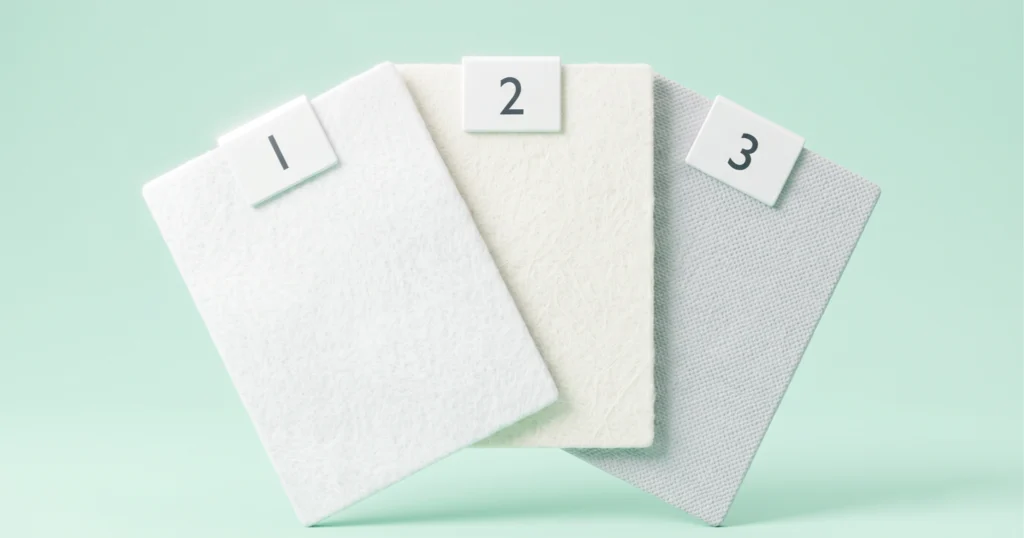
ADL material selection is more complex than topsheet selection because four significantly different technical routes exist:
Through-Air Bonded (TAB): Lofty, soft, fast acquisition speed. The mainstream choice for mid-to-premium products. The tradeoff is thickness — TAB adds product bulk.
Spunlace: Thinner, flatter profile suited to products pursuing a slim hand feel. Acquisition speed is typically lower than TAB, requiring post-treatment processes to compensate.
Spunbond: Lowest cost, but acquisition and distribution performance are also the most basic. Suitable for price-sensitive product lines.
Composite / Bonded Carded Web: The newest generation — combining different fiber types and densities in a multi-layer structure. The performance ceiling is the highest, but the supplier ecosystem is still maturing. In our sourcing work, we found that this category exhibits the most extreme technical route divergence — different manufacturers interpret “composite ADL” very differently, resulting in far greater performance variability than the other three routes.
Route selection is not an independent decision. It interacts tightly with topsheet and core matching. A topsheet that performs well on a TAB ADL may behave completely differently on a spunlace ADL — because the two have different pore structures and liquid conductance speeds, requiring the topsheet’s hydrophilic treatment to be re-calibrated.
The Rejection Threshold: Not Every Candidate Deserves Full Evaluation
After receiving candidate samples from suppliers, we do not run every sample through the complete evaluation pipeline — that would consume excessive time and laboratory resources.
We set a Rejection Threshold: if a candidate’s third-insult rewet value exceeds a preset engineering red line, that candidate is eliminated immediately — regardless of its performance on other metrics.
Why? Because third-insult rewet is the primary trigger for consumer complaints about “leaking” and “feeling wet.” An ADL that fails under third-insult conditions will almost certainly generate negative reviews in real-world usage.
The Rejection Threshold’s value extends beyond time savings — it forces the engineering team to define “what is unacceptable” before evaluation begins, rather than developing a vague sense that “this one doesn’t seem quite right” after comparing a dozen samples.
Methodology for setting the threshold: Take the same metric value from your currently marketed product as the baseline, multiply by a safety factor. Candidates falling below this line — even if priced 30% lower — do not advance. The hidden cost of negative reviews far exceeds any material savings.
The Coupling Effect Between ADL and Topsheet
The ADL cannot be evaluated in isolation from the topsheet — they form a coupled system.
The topsheet’s hydrophilicity determines the speed and pattern at which liquid arrives at the ADL surface. If the topsheet transmits too quickly (aggressive hydrophilic coating), liquid arrives at the ADL as a high-velocity concentrated burst. If the topsheet transmits too slowly (insufficient hydrophilicity), liquid arrives as a gradual, evenly spread film.
The same ADL, facing these two radically different liquid arrival patterns, may perform in completely opposite ways.
This is why “an ADL that tested well in the supplier’s lab doesn’t work in your product” is such a common experience — the supplier tested with their standard topsheet, which differs from yours. ADL performance is not an absolute value. It is a conditional value relative to the entire system.
Recommendation for brands: When evaluating ADL candidates, always test with your own topsheet — never with the supplier’s standard topsheet. This is a step many teams skip, but it is the lowest-cost method to prevent “lab results that don’t match real product performance.”
When to Reassess Your ADL
If any of the following situations are occurring, the ADL may be the first component to investigate — not the core:
Your product performs normally after the first two insults but deteriorates noticeably on the third. This is typically not a core capacity issue (if the first two insults were fine, capacity is adequate) — it is the ADL failing to distribute liquid to unused core regions as saturation approaches.
You changed the topsheet material without correspondingly adjusting the ADL. The topsheet-ADL system is coupled — changing one half changes the operating conditions for the other.
A competitor achieves lower rewet values with a similar core configuration. After controlling for topsheet differences, the ADL is the most likely explanatory variable.
Consumer feedback concentrates on “overnight leaking” rather than “daytime leaking.” Overnight use means longer wear time and more insults — precisely the scenario where ADL performance differences are amplified.
The ADL is one of the highest-ROI optimization levers in diaper engineering — every gram of material improvement is amplified by the system. We are preparing a comprehensive ADL engineering guide covering material selection through supplier evaluation. Follow our Insights page to be notified when it publishes.
This article is based on laboratory test data from our team’s baby diaper and training pants development work. Specific test parameters and supplier information have been anonymized.
For a comprehensive treatment of ADL engineering across all five process routes, see our ADL Layer: Complete Engineering Guide.