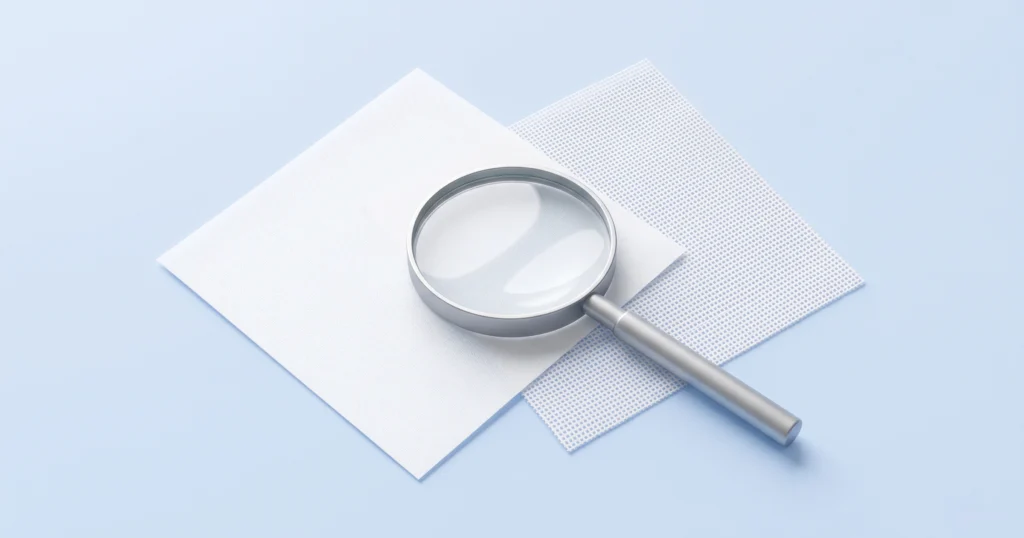
Watch a retail buyer evaluate a new diaper for the first time. They do not open the package. They squeeze it through the bag. That squeeze lands on the outer nonwoven.
A clarification that frequently gets confused outside the industry: the “bottom” of a diaper is not one layer — it is two. The backfilm is a plastic membrane responsible for preventing liquid from reaching clothing — a functional component. The outer nonwoven (sometimes called the back sheet) covers the backfilm’s exterior and is the outermost surface a consumer can touch — a perceptual component.
Every diaper requires both. The materials are completely different (plastic film vs. nonwoven fabric), and the supplier ecosystems do not overlap.
This article discusses the outer nonwoven — the layer that determines “how it feels when you squeeze it through the bag.”
Why the Outer Nonwoven Is Undervalued
In product development priority rankings, the outer nonwoven almost always finishes last. The topsheet determines skin comfort. The core determines absorption performance. The ADL determines dryness. The backfilm prevents leaks. The outer nonwoven? Its engineering function is simply “wrap the backfilm, provide touch and appearance.”
But this ranking overlooks something: before a consumer opens the package, before they feel the topsheet, before the product is worn by any baby — the only surface they can touch is the outer nonwoven.
In retail channels, this is amplified tenfold. Retail buyers evaluating products for category reviews must assess dozens of competing products in limited time. Their process is not to open each one and run comparison tests — they pick it up, squeeze through the packaging, and form an initial impression in two seconds.
Whether your product registers as “soft” or “stiff” is determined in those two seconds. And that determination is 100% driven by the outer nonwoven.
Four Outer Nonwoven Routes: The Core Engineering Differences
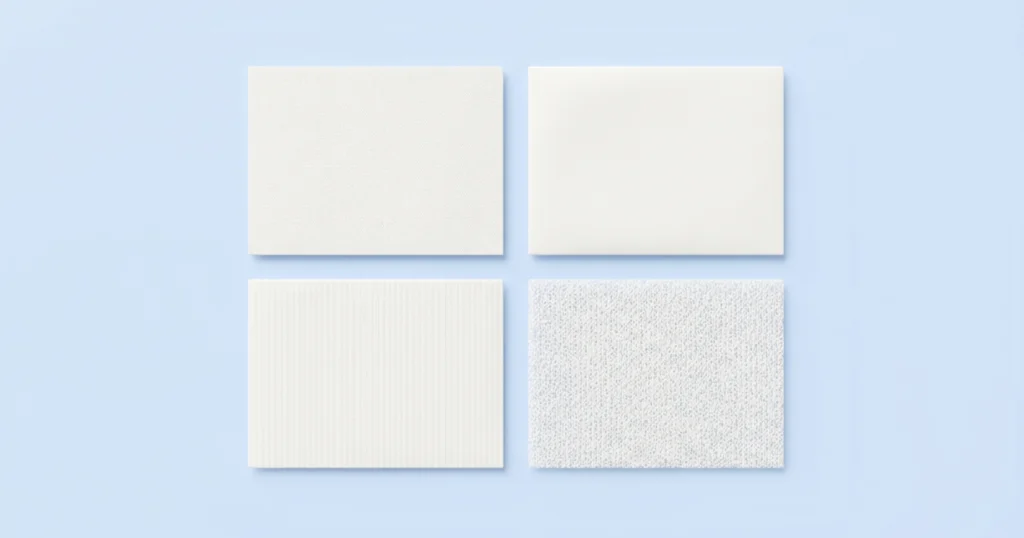
Four primary technology routes exist. Most product development decisions ultimately come down to the first two:
Through-Air Bonded Carded Web (TABCW): Fibers are bonded through hot air into a lofty web structure. Surface is pillowy, hand feel is soft and plush. This is the mainstream choice for mid-to-premium diapers. Cost is higher, and the lofty structure adds product thickness — but the tactile advantage over other routes is decisive. More detail on this material’s properties follows below.
Spunbond: Fibers are melt-spun directly into a dense, flat web. Lowest cost, highest tensile strength — but the hand feel is stiff, with a noticeable “plastic film” sensation when crumpled. The default choice for price-driven products. At lower price points, consumers are less sensitive to outer layer feel, and spunbond’s cost advantage can be fully captured.
Spunlace: Fibers are entangled through high-pressure water jets. Hand feel falls between TABCW and spunbond — significantly softer than spunbond, slightly less lofty than TABCW. Process flexibility is higher, enabling richer surface texture variations.
Cold-Rolled / Calendar Bonded: Bonded through mechanical pressure. Occupies a niche for specific cost-performance requirements but is less commonly specified for mainstream products.
Inside TABCW: Softness Is Not One Dimension — It Is Two
Once you have selected the TABCW route, the word “soft” needs to be decomposed further. When a consumer or buyer’s fingers contact the outer nonwoven, they perceive not a single “soft vs. hard” signal, but at least two independent tactile dimensions:
Horizontal Smoothness: The friction sensation as fingers slide across the material’s surface. High smoothness = fingers glide freely, like touching silk. Low smoothness = fingers catch and drag, like touching terry cloth. Horizontal smoothness is primarily governed by fiber surface treatment and the embossing pattern of the nonwoven surface.
Vertical Loftiness: The compression-rebound sensation as fingers press into the material. High loftiness = pressing down produces an airy “spring-back” feel. Low loftiness = pressing down feels solid, “bottoming out.” Vertical loftiness is governed by fiber inter-layer structure, hot-air bonding intensity, and basis weight.
Two TABCW samples that both feel “very soft” may achieve softness through completely different mechanisms. One might be “smooth but flat” (silky surface but no compression rebound). The other might be “lofty but rough” (good spring-back but finger drag on the surface). Consumers will not articulate these two dimensions separately — they will simply say “this one is better” — but in A/B comparisons, their preferences consistently and reliably point toward the sample that scores high on both.
Implication for product development: When evaluating outer nonwoven samples, do not rely on a single “touch it and say good or bad” assessment. Have evaluators perform two separate actions: slide fingers horizontally (assessing smoothness) and press vertically (assessing loftiness). Decomposing a vague “softness” judgment into two independently optimizable engineering dimensions.
How Process Parameters Shape Hand Feel: It Is Not Just About Fiber Selection
A fact that is easy to overlook: identical raw fibers, processed through different parameter settings, can produce outer nonwovens with dramatically different hand feel. The final tactile outcome is not just “which fiber was selected” — it is the cumulative result of every stage in the process chain: fiber → carding → hot-air bonding → finishing.
Several process stages have the most direct impact on hand feel:
Carding machine settings: Carding opens compressed fiber bales into a uniform fiber web. Carding intensity and speed directly affect fiber orientation and opening degree. Too gentle = fiber clumps remain, creating a granular surface texture. Too aggressive = fiber breakage rate increases, reducing finished strength. The number of carding passes also affects uniformity — more passes produce more even webs, but at higher equipment cost and throughput reduction.
Hot-air oven temperature and airflow: Through-air bonding works by melting the sheath layer of bicomponent (sheath-core) fibers, which then bonds neighboring fibers and locks the web structure. Oven temperature determines “how much melting occurs.” Temperature too low = insufficient bonding, resulting in a loose web that sheds fibers. Temperature too high = over-bonding, collapsing the inter-fiber air pockets that create loftiness. The optimal temperature window is typically only a few degrees wide — and it shifts with natural batch-to-batch variation in fiber melting points, requiring continuous production-floor adjustment. Airflow speed affects how uniformly heat penetrates the fiber web — too slow creates a temperature gradient between top and bottom layers, producing inconsistent softness through the material’s thickness.
Calendar finishing / post-processing: Some manufacturers add a calendar pass after hot-air bonding to improve print quality on the outer surface (spunbond prints crisply; TABCW’s lofty surface causes slight ink bleed). However, calendaring physically compresses the inter-fiber structure, directly sacrificing vertical loftiness. This is an explicit tradeoff between hand feel and print quality — no method achieves both simultaneously.
What this means for sourcing: When evaluating suppliers, you are not just evaluating “what fiber they use.” You are evaluating the parameter control capability of their entire process chain. Two manufacturers using identical fiber inputs can produce outer nonwovens that feel completely different — because of differences in carding settings and oven temperatures. This is why “samples produced under production conditions” are far more informative than “samples produced under laboratory conditions.” A laboratory can carefully tune parameters to create one perfect swatch. But the ability to control parameter drift under production speeds is what you are actually paying for.
Three Hidden Parameters That Still Matter
Even after the process route and parameters are set, three specifications continue to fine-tune final hand feel:
Basis Weight (GSM): Higher GSM = more substantial hand feel. Industry-standard outer nonwoven basis weights range from 10 to 25 GSM. Consumers can clearly distinguish 10 from 20 by hand — but the difference between 18 and 22 requires careful side-by-side comparison. Each additional GSM adds cost approximately linearly.
Fiber Denier: Finer fibers = softer hand feel (horizontal smoothness improves significantly). But excessively fine fibers break more frequently during high-speed production, reducing yield and increasing downtime. The optimal range balances cost, hand feel, and production stability.
Embossing Pattern: The outer nonwoven surface can be embossed via heated rollers to create raised patterns. 3D patterns enhance perceived softness — fingertips contact only the pattern peaks rather than the full surface, concentrating pressure into smaller areas that the brain interprets as “softer.” Pattern depth, density, and geometry all affect the outcome. Changing the embossing roller die is a near-zero-cost differentiation opportunity — yet most brands use the supplier’s default pattern without ever actively choosing.
Sound: A Rarely Discussed Dimension That Consumers Notice
In consumer reviews, “sounds like a plastic bag” is a recurring negative keyword. This “plasticky” sound originates from two sources: the backfilm and the outer nonwoven.
The backfilm is a PE membrane — crumpling it naturally produces a rustling noise that is difficult to eliminate entirely. But the outer nonwoven selection significantly amplifies or dampens the sound transmitted from the backfilm. TABCW’s lofty fiber structure naturally absorbs acoustic energy — when the backfilm crumples and vibrates, the outer TABCW layer acts as acoustic insulation, attenuating the sound. Spunbond’s dense structure transmits sound more efficiently — consumers hear a more pronounced rustle.
For brands positioning around “gentle” and “natural,” the outer layer’s sound-dampening property is not a trivial detail — it is part of brand perception consistency.
The Print Tradeoff
When consumers unbox a diaper, the first thing they see is not the topsheet (which faces the baby’s skin, on the interior) but the outer nonwoven’s printed surface — carrying the brand graphics and size markings.
Spunbond’s flat surface delivers the crispest print resolution and color saturation. TABCW’s lofty surface causes slight ink bleed into fiber interstices.
This creates an inherent tension in outer nonwoven selection: the best-feeling material (TABCW) produces the worst print quality; the best-printing material (spunbond) produces the worst hand feel. This tradeoff must be explicitly acknowledged and resolved during the development phase.
Recommendations for Product Development Teams
Add a five-minute outer nonwoven blind test to your next product review. Cut three different options — different process routes, basis weights, and embossing patterns — into identical sizes, number them, and have team members perform two actions with eyes closed: slide fingers horizontally (smoothness rating) and press vertically (loftiness rating). You will find remarkable consensus on “which is best” — but this judgment has likely never been systematically incorporated into your specification decisions.
When discussing specs with outer nonwoven suppliers, do not limit the conversation to basis weight and tensile strength. Request samples across different embossing patterns and denier ranges for tactile comparison. More importantly, request samples produced under production conditions — not laboratory showcase pieces.
Before shipping product to a retail buyer for category review, have someone unfamiliar with the product squeeze it through the bag. If their first reaction is “this feels stiff” or “feels like plastic” — the outer nonwoven needs an upgrade. The retail buyer’s reaction will be identical.
The outer nonwoven is one of the most undervalued optimization levers in product development — a modest material upgrade can dramatically shift how consumers and buyers perceive your product on first contact. In our comprehensive development guide, outer nonwoven evaluation is positioned as the second priority in the material selection phase — immediately after the topsheet.
This article is based on our team’s experience in baby diaper material evaluation and retail channel engagement. Specific supplier information and retail review details have been anonymized.