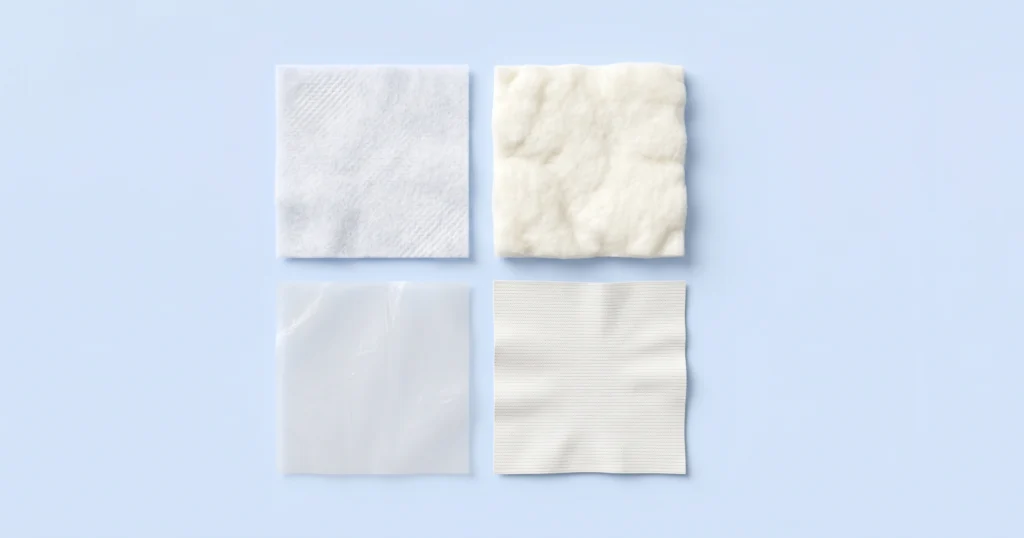
The client's product uses a cotton topsheet. So does the competitive benchmark. To consumers, these are the same material — both packages say "cotton." Under fiber-level magnification, they are two completely different engineering systems.
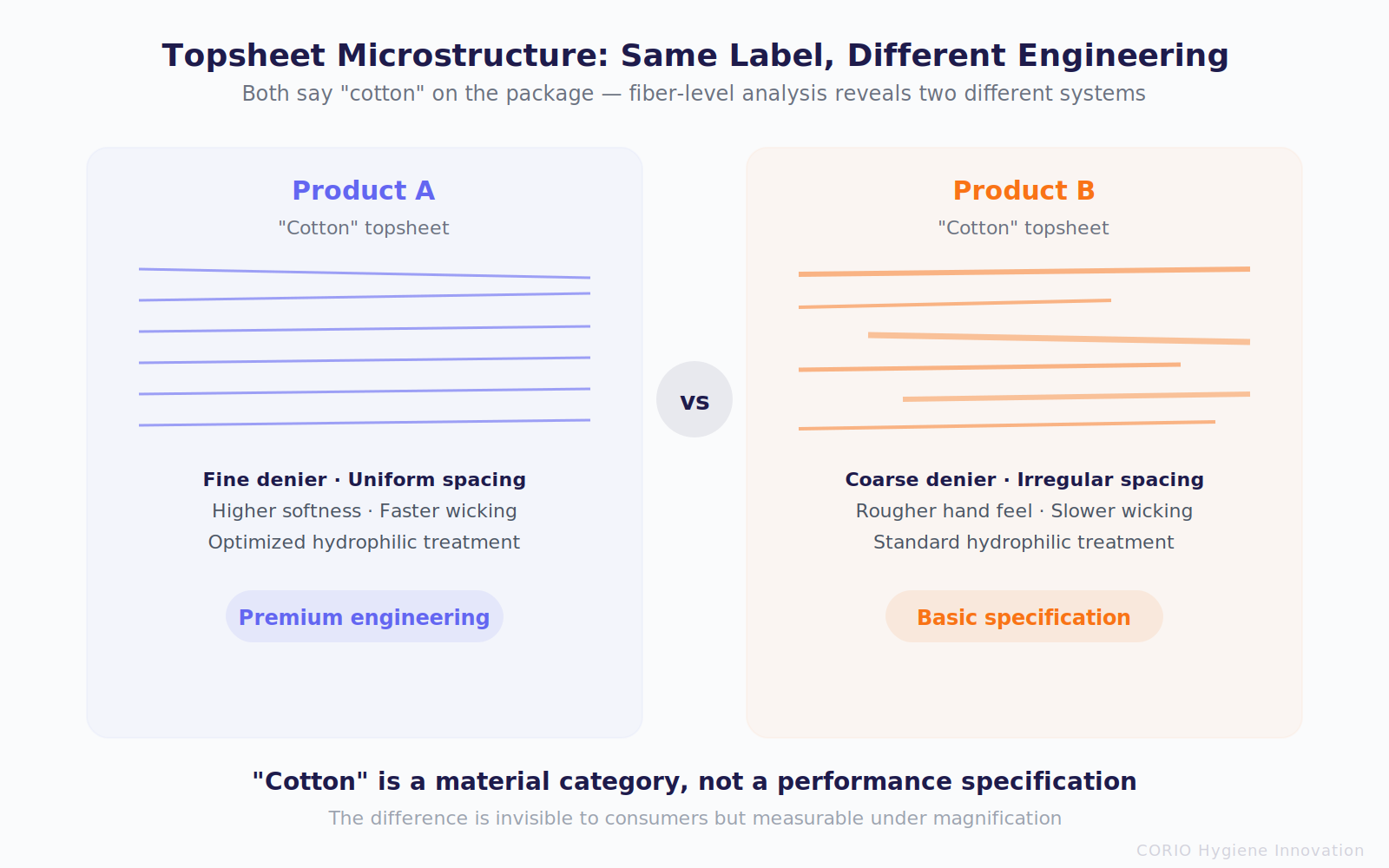
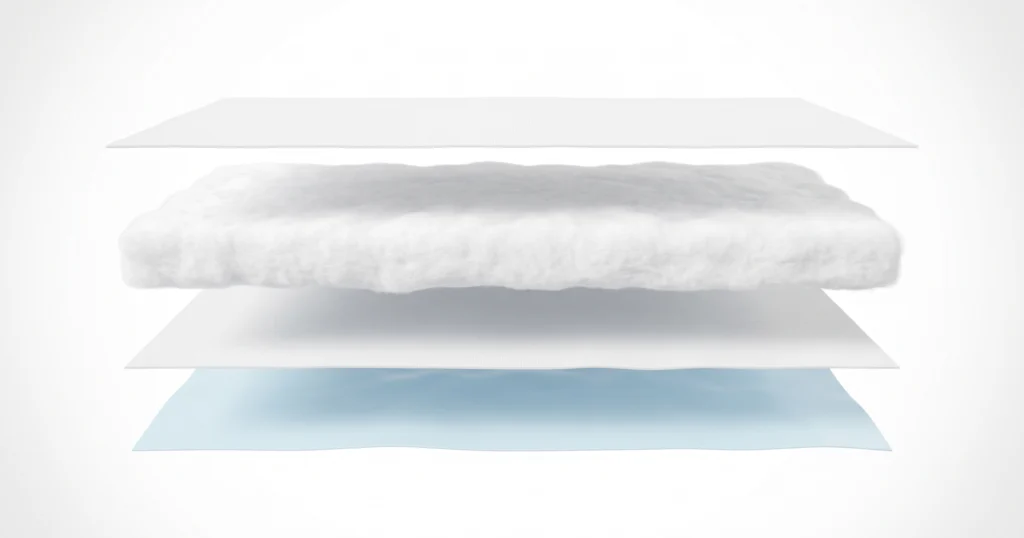
We conducted microstructural comparison imaging and layer-by-layer functional analysis of both topsheet materials. The client uses 100% cotton spunlace nonwoven — fibers hydroentangled into a single-layer structure. Softness is excellent, but inter-fiber pore size is large: liquid penetrates quickly, but so does rewet. The competitor uses a cotton spunbond base layer plus a cotton spunlace face layer — a dual-layer composite where the spunbond provides structural strength and capillary networks, while the spunlace maintains tactile softness. The two layers work in concert to achieve both rapid liquid intake and surface dryness retention.
This structural difference directly explains the performance divergence observed in testing: the single-layer spunlace topsheet absorbs the first dose quickly but shows significant rewet degradation under multi-dose stress. The dual-layer composite is slightly slower on first dose but maintains stable rewet control across multiple additions. Behind the consumer perception of "equally soft" lies a completely different fluid management architecture.
For the client, this discovery changed the logic of material evaluation: comparing "whether it's cotton" or "whether it feels soft" is insufficient — evaluation must reach the fiber structure level to understand each cotton topsheet's engineering behavior. This is why, in subsequent topsheet supplier screening, we used "fiber structure type" as the first screening dimension rather than "cotton percentage."