
Asia’s largest hygiene exhibition just wrapped up. Three days, over 800 exhibitors, covering the complete value chain from raw fiber to finished-goods equipment.
Most trade show recaps give you an exhibitor list and a few booth photos. This article does neither.
We walked in with a shortlist of nearly twenty suppliers, a layered visitation strategy, and three technical hypotheses that needed field validation. Three days later, we walked out with three material-level discoveries that shifted how we think about the supply chain.
If you’re a North American brand developing products through Asian supply chains, these trends deserve your attention.
Trend 1: Cotton Topsheet Process Routes Are Diverging
Eighteen months ago, if you asked a supplier for a “cotton topsheet,” you’d get essentially one answer — through-air bonded carded web. It’s the industry standard: mature, stable, widely available.
What we found on the exhibition floor was different.
At two supplier booths in the same exhibition hall, we examined cotton topsheet materials produced via two entirely different process routes. Their spec sheets were nearly identical — same basis weight, same fiber diameter, same cotton content. But the hand feel and performance characteristics were noticeably different.
Hold both samples in your palm and the contrast is immediate. One feels like a woven cotton handkerchief — soft but dense, the surface smooth, fibers tightly arranged. The other feels like cotton candy — airy, almost weightless, but more fragile, as if it might come apart under pressure.
This isn’t a “good versus bad” distinction. It’s two engineering trade-offs.
The first route prioritizes liquid strike-through speed — the surface architecture features deliberately designed apertures that let urine pass through quickly. The trade-off is a less “textile-like” feel. The second route prioritizes skin-contact experience — the fiber arrangement creates a knit-fabric softness, but the more enclosed surface structure reduces penetration efficiency by roughly fifteen to twenty percent.
What this means for brands: When your spec sheet reads “100% cotton topsheet,” you’ve defined the raw material composition, but you haven’t defined the process route. Two routes can produce materials that both satisfy your spec, yet deliver entirely different consumer experiences — one feels like premium baby clothing, the other more like conventional diaper facing. You need to add process-direction constraints to your specification — or better yet, run a blind comparison test of both routes side by side and let the data decide, rather than relying on subjective hand-feel impressions.
Trend 2: The ADL Layer Is Becoming the System’s Control Variable
Most brands focus their performance discussions on two places: the topsheet (what consumers see and touch) and the core (where liquid gets locked). The ADL — Acquisition and Distribution Layer, that thin nonwoven sheet sandwiched between the topsheet and core — almost never appears in brand-level strategy conversations.
The exhibition changed that perception.
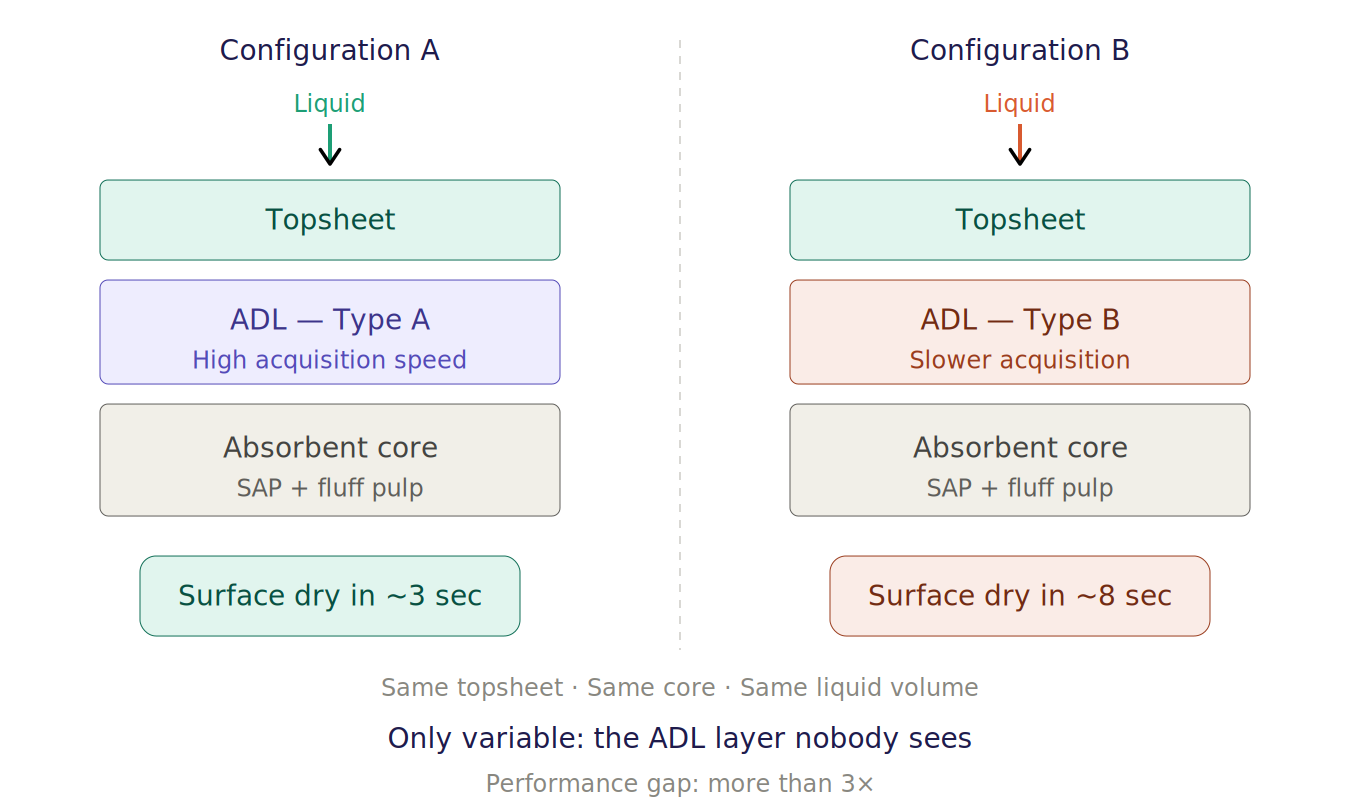
At one specialized ADL supplier’s booth, we watched a simple but revealing live demonstration. The supplier’s engineer placed a standard topsheet material over two different ADL samples, one after the other. Then, using a standardized syringe, injected identical volumes of test fluid at the same rate.
First pairing — liquid disappeared from the topsheet surface in roughly three seconds. By ten seconds, the topsheet felt essentially dry to the touch. Second pairing — same topsheet, same liquid volume — disappearance took over eight seconds. At fifteen seconds, the surface still felt noticeably damp.
Same topsheet. Same liquid volume. The only variable was the layer underneath — the layer consumers never see. Performance gap: more than three times.
Another signal worth noting: at least three raw material suppliers were promoting ADL as an independent product line, rather than positioning it as an accessory to topsheet or core materials. One had even set up a dedicated “ADL Solution Center” within their booth, staffed with specialized engineers for live demonstrations and technical consultations. This means the technical decision space for ADL is expanding — both hot-air and spunlace process routes now have specialized suppliers competing on differentiation, and entirely new ADL architectures are appearing.
What this means for brands: In your next product development cycle, elevate ADL from “default configuration” to “engineering decision variable.” Ask your supply chain partner to treat ADL selection as a standalone evaluation step, rather than letting the finished-goods manufacturer pair whatever they have on the line. If your product currently struggles with rewet or insufficient dryness, try changing the ADL before changing the topsheet — you may get a bigger improvement at lower cost.
Trend 3: Raw Material Suppliers Are Offering “Technical Services,” Not Just Materials
The traditional raw material supply chain relationship is simple: brand defines specs, finished-goods manufacturer selects materials, raw material supplier ships to order. The raw material supplier’s role is “material supply,” not “technical consulting.”
At the exhibition, we observed a clear shift: several leading raw material suppliers are proactively offering technical services that extend well beyond the material itself.
One supplier’s booth showcased not product samples, but a complete material selection decision tool — including performance prediction models for different process parameter combinations. Their engineers weren’t pushing any single product; they were helping visitors understand “given your specific application scenario, which parameter combination makes the most sense.”
Another supplier, in a private meeting room, walked us through a custom topsheet development project they’d completed for a client — from fiber blending experiments to small-batch sampling to performance validation, spanning roughly three months, the entire workflow executed by the raw material supplier rather than the finished-goods manufacturer. What the client received wasn’t a material price quote, but a validated, production-ready process specification.
The underlying logic isn’t hard to understand. As raw materials commoditize, the margin from selling material alone keeps compressing. Raw material suppliers need a way to become “irreplaceable” — and “helping you solve technical problems” is harder for competitors to replicate than “shipping faster.”
What this means for brands: This is a trend you should actively leverage. If your raw material supplier is willing to provide technical collaboration beyond the transactional level, it effectively lowers your development risk — you no longer have to rely entirely on the finished-goods manufacturer for material-level technical decisions. But watch for one inherent risk: a raw material supplier’s technical advice will naturally lean toward recommending their own products. A topsheet supplier is unlikely to tell you “your topsheet is fine — the problem is your ADL.” You need an independent technical filter to verify whether their recommendations truly optimize your product — or just optimize their share of your BOM.
Beyond the Exhibition Floor
Three days at a trade show won’t change an industry. But they can expose trend shifts that are hard to detect in the daily back-and-forth of emails and spec sheets.
These three discoveries — topsheet process divergence, rising ADL importance, and the evolution of raw material supplier roles — aren’t isolated events. They point in the same direction: Asia’s hygiene supply chain is upgrading from “build to spec” to “engineer to performance.” For North American brands that rely on this supply chain, that’s both opportunity and challenge.
The opportunity: more technical options mean more room for product differentiation. The challenge: more technical options also mean you need stronger technical judgment to make the right calls — not more supplier business cards.
The brands that will benefit most from these trends aren’t the ones with the most supplier relationships. They’re the ones with the sharpest technical filters.
This article is part of our supply chain engineering series. For a deeper dive into why the ADL layer deserves more attention than it typically receives, see our complete guide: [The ADL Layer: A Complete Engineering Guide to the Most Underestimated Component in Diaper Design]. For the methodology behind how we structured this exhibition visit, see: [Approaching INDEX™26 Geneva: What a Supply Chain Engineer Looks For].