
Once every three years. Geneva. The global nonwovens and hygiene industry’s most important technical exhibition.
Most attendees will tell you they “got a lot out of it.” But press them on what specifically, and the answer is typically a stack of business cards, a few product brochures, and a vague sense that “the industry is moving in some direction.”
That’s not an exhibition problem. It’s a methodology problem.
INDEX is not a show you can browse. Its value lies not in booth count, but in concentrating the complete value chain — from fiber spinning equipment makers to topsheet material suppliers to brand product managers — under one roof. In a single venue, you can access the machine builder behind a spunlace line, the material supplier selling the output, and the brand executive deciding whether to specify it.
But that’s also the challenge: information density is extreme, and so is noise. Without a clear information-capture framework, you may leave after three days with 200 business cards, a stack of brochures, and no single structured insight you can convert into a decision.
We recently completed a full-scale assessment at Asia’s largest equivalent exhibition. Based on that experience and the framework we validated there, here’s the engineering methodology we use for structured trade show intelligence.
Pre-Show: Hypothesis-Driven, Not Information-Gathering
Most teams prepare for exhibitions by confirming the exhibitor directory, circling companies they want to meet, and scheduling appointments.
This workflow is missing a critical prerequisite: arrive with hypotheses to validate, not information to collect.
The difference: “collecting information” is open-ended — you never know when you have enough. “Validating hypotheses” is closed-ended — each hypothesis either gets confirmed, rejected, or flagged for more data.
A concrete example. At our most recent exhibition, one of our hypotheses was:
“Hypothesis: At least one topsheet supplier at the exhibition can produce a cotton material that achieves both our target softness level AND our target strike-through speed simultaneously — without requiring a trade-off between the two. Validation method: Request samples from every cotton topsheet exhibitor; run standardized comparison tests within 48 hours of returning.”
This hypothesis directed us to topsheet supplier booths with precision, asking targeted technical questions — not “what’s new?” (open-ended information gathering), but “do you have a cotton topsheet that can hit this softness grade without sacrificing penetration speed?” (closed-ended hypothesis validation).
Our experience: 3–5 hypotheses is the optimal number for a trade show. Fewer than 3 underutilizes the exhibition’s resources. More than 5 fragments your attention. Each hypothesis should have a clear validation method and an actionable conclusion — “if confirmed, our next step is X; if rejected, it means Y.”
Floor Strategy: Structured Visits + Free Exploration
Exhibition time is finite. We use a 70/30 allocation principle:
70% of time for structured visits. These are your pre-confirmed “must-see” list — suppliers or technology directions directly relevant to current projects. Each visit has a defined objective: validate a hypothesis, capture a parameter, confirm a capability.
30% of time for free exploration. This is deliberately reserved serendipity.
One practical recommendation: schedule free exploration for the final day. The first two days of structured visits build a baseline — you now know what “normal” looks like. Exploring on top of that baseline makes it far easier to identify genuinely differentiated offerings, rather than being attracted by every booth’s “innovation” signage.
At our most recent exhibition, the 30% free-exploration window produced two strategic discoveries that weren’t on any pre-show shortlist: a new material category we hadn’t previously considered, and a testing services provider that could become a long-term partner. Both may have a larger impact on our business over the next six months than any supplier on the structured list.
If we had allocated 100% of our time to structured visits, those discoveries wouldn’t have happened.
On-Site Capture: Record the Moment You Leave
The biggest information loss at exhibitions isn’t “didn’t see it” — it’s “saw it but didn’t record it.”
You spend 20 minutes at a booth discussing technical directions, examining samples, collecting a card. Turn to the next booth, and 20 minutes later most details from the previous stop have blurred. By evening, the dozen-plus suppliers you visited have blended into an indistinct mass.
Our method: immediately after leaving each booth, spend 5 minutes completing a standardized rapid-capture form. Not recalled afterward — recorded on the spot.
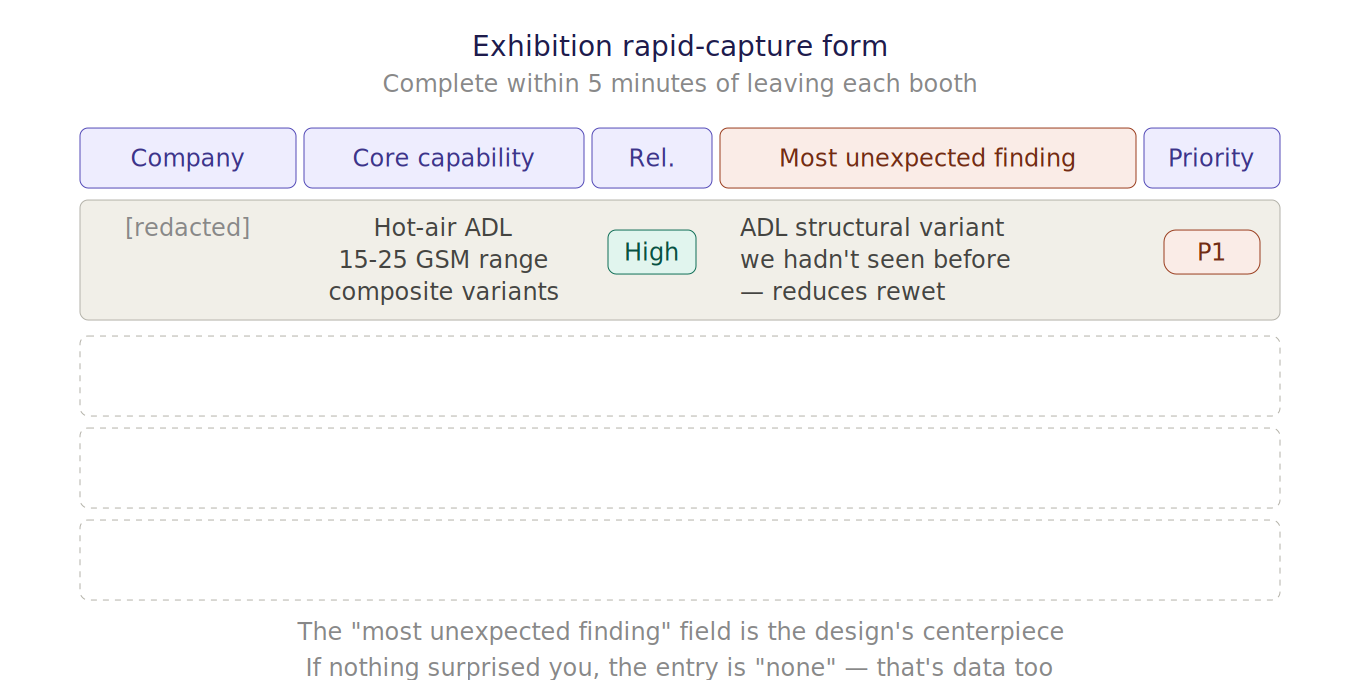
The form has just five fields:
Company | Core capability (one sentence) | Relevance to current project (H/M/L) | Most unexpected finding | Follow-up priority (1/2/3)
A filled-in example (anonymized):
[Supplier name redacted] | Hot-air ADL, 15–25 GSM range, composite variants available | High | Offered an ADL structural variant we hadn’t seen before — reduces rewet under compression | Priority 1
The “most unexpected finding” field is the design’s centerpiece. It forces you to distill one high-density insight before walking away. If a booth offered nothing surprising, the entry is “none” — which is itself a valuable data point (this supplier is within your existing knowledge, no incremental value).
By the end of the exhibition, your rapid-capture forms constitute a structured intelligence log organized chronologically — not a pile of fragments you have to reconstruct from memory.
Post-Show: Complete Structured Processing Within 48 Hours
The first 48 hours after returning from an exhibition are the golden window for information processing — beyond this, your memory degrades rapidly, and the shorthand on your forms becomes indecipherable even to you.
Our post-show framework covers three dimensions:
Technical discovery ranking: Aggregate all “most unexpected findings” and rank by impact on current projects. The top 3–5 are your exhibition’s core output. At our most recent show, the top three discoveries were: a novel ADL process route, a divergence in topsheet manufacturing approaches across suppliers, and signals that raw material suppliers are repositioning toward technical services. Each eventually became a standalone article.
Supplier tiering: Sort all visited suppliers into three groups — “immediate follow-up” (directly relevant and capability verified on-site), “watchlist” (promising but not urgent), “no further action” (clear mismatch). In our case, three days and roughly 30 supplier visits yielded just 5 in the “immediate follow-up” tier — fewer than one in six. Most visits confirmed “this supplier doesn’t fit our current project” — which is equally valuable information, because it narrows your search space.
Hypothesis validation status: Return to your pre-show 3–5 hypotheses — which confirmed? Which rejected? Which unresolved? Unresolved hypotheses become priority items for subsequent work. A clearly rejected hypothesis is also valuable — it stops you from investing further resources in an infeasible direction.
The Exhibition’s Real Value
Trade shows aren’t procurement channels — at least not for brands making strategic supply chain decisions.
The real value of an exhibition is compressing the time dimension of information acquisition. Industry shifts that would normally take 3–6 months to detect through emails and video calls can be captured in 3 concentrated days. But only if you have an information-capture framework — otherwise, you’re just collecting the same volume of noise in less time.
Hypothesis-driven + 70/30 allocation + record-on-exit + 48-hour processing — this isn’t a perfect framework. But at our most recent exhibition, it produced three material-level trend discoveries, five immediately actionable supplier leads, and two unplanned strategic directions. That output density far exceeded any exhibition we’d attended previously.
Before your next trade show, write down three hypotheses you want to validate. If you can’t name three, you’re not ready to go.
This article is part of our exhibition methodology series. For what we actually discovered using this framework, see: [CIDPEX 2026: Three Material Trends North American Brands Should Watch].