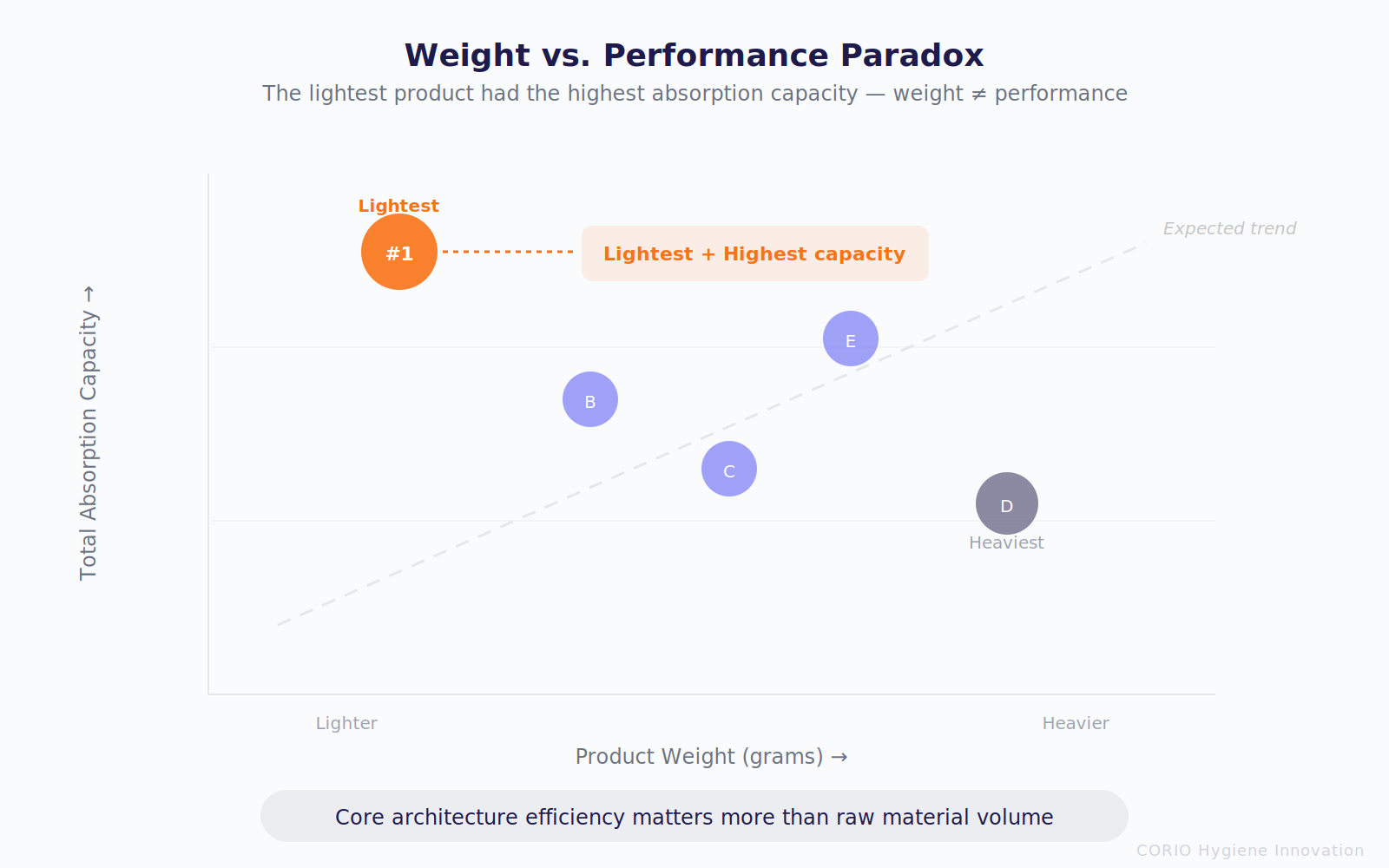
Across a five-brand horizontal comparison, we found a counter-intuitive fact: the lightest product in the set (approximately 32g) had the highest total absorption capacity, while the client’s product — the heaviest (approximately 38g) — ranked near the bottom in absorption.
The thickness dimension was equally counter-intuitive: the client’s product measured approximately 10mm, the thickest in the set. The thinnest competitor measured approximately 6mm — a gap exceeding 4mm, which is a difference consumers can directly perceive by touch. Yet this thinnest competitor performed competitively on dryness metrics.
This exposed a relationship widely misunderstood in the industry: more material ≠ better performance. The key is not “how much you put in” but “how you arrange it.” Composite cores optimize SAP spatial distribution and carrier layer structure to achieve a higher performance ceiling with less total weight. Traditional fluff pulp cores, where fibers occupy significant volume, are heavy and thick but absorb inefficiently.
For the client, this was not just an engineering discovery — it directly impacted cost structure and consumer experience. Lighter means lower shipping and material costs. Thinner means better wear comfort and better shelf presentation. Best performance, lowest cost, best experience — all three can move in the same direction.