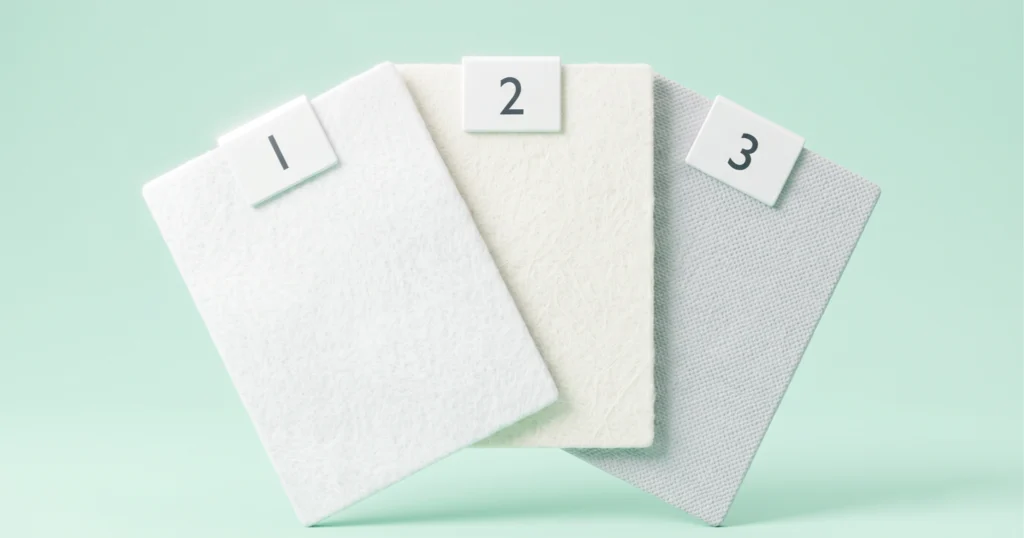
Most brands optimize the layers consumers see. The layer that actually controls performance is the one they skip.
Here is a question that reveals more about a product team’s engineering depth than any technical spec sheet: when you disassemble a competitor’s product, which layer do you examine last?
For most brands, the answer is the acquisition distribution layer — the ADL. It sits between the topsheet and the absorbent core, invisible to the consumer, absent from marketing materials, and routinely overlooked in product optimization discussions. Product teams spend months debating topsheet softness and core absorbency. The ADL gets a line item on the BOM and a default specification from the manufacturer.
This is a mistake. In our engineering practice, we have found repeatedly that the ADL is the single most influential layer in determining real-world product performance — particularly for the metric that matters most to consumer satisfaction: rewet.
What the ADL Actually Does
The acquisition distribution layer serves two functions that sound simple and are mechanically complex. First, it captures liquid from the topsheet surface and transfers it downward into the absorbent core. Second, it distributes that liquid laterally across the core’s surface area, preventing localized saturation that leads to leakage.
The first function determines acquisition speed — how quickly the product pulls liquid away from the skin. The second function determines how efficiently the core’s total absorption capacity is utilized. A product with a poorly designed ADL can have an excellent core and still leak, because liquid concentrates in one zone rather than distributing across the available absorbent area.
But the ADL’s most critical role — and the one most product teams miss entirely — is its behavior under reverse pressure. After a baby sits, rolls, or is picked up, body weight compresses the absorbent system. The ADL acts as the primary barrier preventing absorbed liquid from migrating back toward the topsheet surface. This reverse migration is what the industry measures as rewet, and it is the metric most directly correlated with overnight comfort, skin health, and caregiver satisfaction.
Two Technology Paths, Fundamentally Different Physics
The current ADL landscape offers two broadly distinct technology paths, and the choice between them produces dramatically different performance profiles.
Nonwoven ADL is the established approach. These are typically through-air bonded or resin-bonded nonwoven fabrics, often using bicomponent fibers or chemically treated surfaces to manage hydrophilicity. The liquid transfer mechanism is primarily capillary action through the fiber matrix. Performance is tuned by adjusting fiber denier, web density, bonding pattern, and surface treatment chemistry.
Nonwoven ADLs are well-understood, widely available, and relatively inexpensive. Their limitation is that capillary-driven liquid transfer is inherently bidirectional — the same fiber structure that pulls liquid down under gravity can wick it back up under compression. Managing this bidirectional behavior requires careful optimization of the fiber matrix properties, and there are physical limits to how much rewet reduction a capillary-based system can achieve.
Formed-film ADL represents the emerging alternative. Instead of a fibrous web, these ADLs use a perforated or three-dimensionally formed polymer film. Liquid passes through defined apertures by gravity and pressure, and the non-porous film surfaces between apertures create a physical barrier against reverse flow. The liquid transfer mechanism is fundamentally different — directional flow through engineered openings rather than bidirectional capillary action through a fiber network.
Formed-film ADLs typically achieve superior rewet performance precisely because of this directionality. The aperture geometry can be engineered to facilitate forward flow while physically blocking reverse migration. However, they tend to have lower total liquid holding capacity than nonwoven ADLs, and their acquisition speed characteristics depend heavily on aperture density, size distribution, and the hydrophilic treatment of the film surface.
Neither technology is categorically better. The optimal choice depends on the specific performance priorities of the product, the adjacent layer specifications, and the target consumer use case. A premium overnight diaper optimizing for minimal rewet faces a different ADL design problem than a daytime training pant optimizing for fast acquisition during active movement.
Why the ADL Is the Performance Bottleneck
In controlled cross-component testing, we consistently observe a pattern that surprises product teams encountering it for the first time. When you hold the core and topsheet constant and swap only the ADL between two product configurations, the performance delta — particularly in rewet — is often larger than when you swap the core itself.
This is counterintuitive. The absorbent core is the largest, heaviest, and most expensive component in the product. It seems logical that it should be the primary performance driver. But the core’s job is storage. The ADL’s job is traffic management — controlling how liquid reaches storage and whether it escapes back. A well-designed ADL paired with a moderate core outperforms a poorly designed ADL paired with a premium core, because the bottleneck is in the transfer, not the storage.
This has direct implications for BOM optimization. Brands investing in more expensive core formulations to solve a rewet problem may be addressing the wrong layer. If the ADL is not efficiently managing liquid transfer and reverse-flow prevention, upgrading the core provides diminishing returns. The correct diagnostic sequence is to characterize ADL performance first, optimize it, and then calibrate the core specification to match the ADL’s transfer profile.
The Spec Sheet Blind Spot
Most product specification sheets list the ADL as a single line: material type, grammage, and width. Sometimes a hydrophilicity value. This level of specification is inadequate for meaningful performance control.
The parameters that actually drive ADL performance include fiber denier distribution (for nonwoven types), aperture geometry and density (for formed films), surface energy gradient from top face to bottom face, compression recovery behavior under cyclic loading, and the interaction profile with the specific topsheet material above it and core surface below it. None of these appear on a standard spec sheet, and most are not routinely measured during incoming quality control.
This creates a situation where two ADL materials with identical spec sheet descriptions — same type, same weight, same nominal hydrophilicity — produce measurably different performance in the finished product. The difference lives in the manufacturing process parameters, fiber selection details, and surface treatment chemistry that spec sheets do not capture.
What This Means for Your Next Product Review
If your product optimization roadmap does not include ADL as a primary variable, you are likely leaving significant performance improvement on the table.
Start with diagnostics. The next time you disassemble a competitor product or evaluate your own, test the ADL layer independently. Measure its acquisition rate, lateral distribution pattern, and rewet contribution in isolation before testing the assembled product. Compare these characteristics across competitors. The variance will likely be larger — and more explanatory of finished-product performance differences — than you expect.
Then consider the system interaction. An ADL change affects optimal specifications for both the topsheet above it and the core below it. Evaluating ADL options in isolation, without modeling these interactions through systematic cross-component testing, produces misleading results. The ADL that performs best on a standalone test bench may not be the ADL that produces the best finished-product performance, because layer interactions can amplify or cancel individual-layer advantages.
The hidden layer is hidden for a reason — it requires more engineering effort to understand and optimize than the visible layers consumers judge on first impression. But for brands serious about performance differentiation, it is where the most consequential design decisions live.
Simon Gong | Founder & CEO, Corio Hygiene Innovation Team
For the complete engineering framework covering all five ADL process routes, see our ADL Layer: Complete Engineering Guide.