We took apart a top-performing training pant from a market where cotton topsheets are standard. What we found inside changed how we think about product architecture.
There is a difference between reading a spec sheet and cutting a product open.
A spec sheet tells you that a training pant has a cotton topsheet, a composite core, and an elastic waistband. What it cannot tell you is how the topsheet’s hydrophobic gradient interacts with the core’s channel geometry to produce a rewet number that neither component could achieve alone.
We recently completed a systematic teardown of a premium pull-up product — one that consistently ranks among the top performers in consumer satisfaction surveys in its home market. The product uses a cotton topsheet, which was our primary reason for selecting it: we wanted to understand how a mature, commercially successful product integrates cotton into a training-pant form factor.
What we found went well beyond the cotton story.
Layer by Layer
The teardown followed our standard protocol: careful separation of each functional layer, photographic documentation at each stage, individual measurement of basis weight, and identification of material type and construction method for every component.
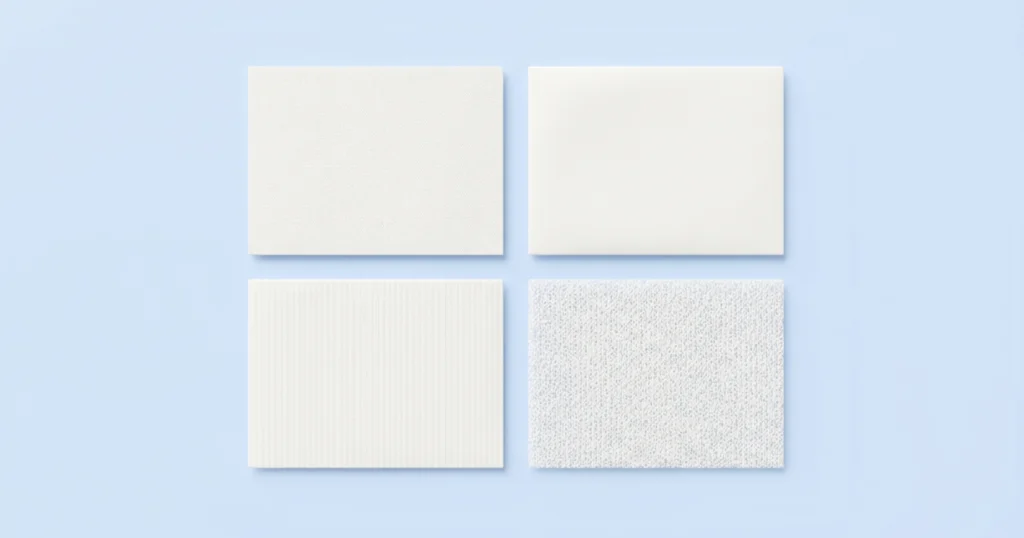
The topsheet was a dual-layer cotton spunlace construction — not a single sheet of cotton nonwoven, but two distinct layers bonded together. The upper layer, which contacts the skin, featured a pattern of apertures (small holes) that facilitate liquid passage. The lower layer was a denser, unpatterned base that provides structural integrity and contributes to rewet control.
This dual-layer design is significant because it creates a directional preference for liquid movement. Liquid passes through the apertures relatively quickly (downward), but the denser lower layer resists reverse flow (upward). The result is a one-directional-bias topsheet — not a simple porous sheet that moves liquid equally in both directions.
The basis weight of this topsheet was approximately 60 GSM — roughly double the weight of a typical single-layer cotton topsheet used in taped diapers. This immediately raised a cost question that we will address later.
The ADL was absent. This was the first surprise. In the taped diaper version from the same brand, a separate ADL layer sits between the topsheet and the core, distributing liquid laterally to prevent localized saturation. In the pull-up version, this dedicated layer was eliminated.
Our initial hypothesis was that the higher-GSM topsheet was performing the distribution function that would normally belong to the ADL. Subsequent testing confirmed this partially — the dense lower layer of the topsheet does provide some lateral spread — but the primary distribution mechanism turned out to be the core itself.
The core was a multi-layer composite structure with no fluff pulp, built around a dual-SAP configuration separated by a nonwoven spacer. The distribution channels pressed into the core body were visible after wetting — subtle grooves that became apparent as the SAP swelled around them. These channels were not visible in the dry product, which matters for consumer perception: parents who dislike the appearance of grooved cores would not notice them in this design.
The backsheet was a breathable film-nonwoven laminate — standard for the premium tier. Nothing unusual here, but the breathability specification was notably high, which makes sense given the composite core’s lower air permeability compared to a fluff-pulp core.
The Cross-Swap Experiment
The teardown alone would have been informative. What made it transformative was what we did next.
We designed a variable-swap protocol: take individual layers from this product and combine them with layers from a different product platform (a US-market premium diaper with a traditional fluff-pulp core and a thinner cotton topsheet). By swapping one layer at a time while holding everything else constant, we could isolate the contribution of each component.
We tested six combinations across two phases. Two combinations were eliminated immediately — both involved removing the ADL from the US product without replacing it with the higher-GSM topsheet. Without either distribution mechanism, absorption speed degraded by over 120%. This confirmed that the ADL is not optional in a system with a thinner topsheet; it is structurally necessary.
The remaining combinations revealed a hierarchy of component influence. The core architecture was the dominant variable, driving the largest performance deltas across both absorption speed and rewet control. The topsheet was the second most influential variable, primarily affecting first-insult rewet. The ADL type (thermal-bond versus perforated film) had a measurable but smaller effect.
The optimal combination — the thicker cotton topsheet paired with the US product’s thermal-bond ADL and the composite channel core — outperformed both original products on every measured metric. Not incrementally. The third-insult rewet improved by more than 40% compared to the better-performing original.
Three Engineering Lessons
Lesson one: components interact non-linearly. The performance of the composite core was good on its own. The performance of the thick cotton topsheet was good on its own. But the combination of both produced results that exceeded what either component’s individual contribution would predict. The topsheet’s directional-bias structure feeds liquid into the core’s distribution channels more efficiently than a thinner, single-layer topsheet, creating a coupling effect that amplifies both components’ strengths.
This means that evaluating components in isolation — as most spec-sheet-driven procurement processes do — systematically underestimates the performance of well-matched systems and overestimates the performance of mismatched ones.
Lesson two: absence can be a design choice. The elimination of the ADL in the original pull-up product was not a cost-cutting measure. It was an architecture decision enabled by the higher-GSM topsheet and the composite core’s built-in distribution capability. The system was redesigned so that the ADL’s function was absorbed by the layers above and below it.
This has implications for cost analysis. The product looks more expensive on a BOM basis (higher topsheet GSM means higher topsheet cost). But the elimination of the ADL layer saves material cost and converting complexity. Whether the net cost is higher or lower depends on the specific material prices — but the point is that a naive BOM comparison would penalize this design for its topsheet cost without crediting it for the ADL elimination.
Lesson three: market-leading products are not always market-visible products. This pull-up is a top seller in its home market. It is not sold in the United States. A brand team that benchmarks only against products available on US shelves would never encounter this architecture — and would never discover that a cotton topsheet can be engineered to eliminate the need for a separate ADL.
The most informative competitive intelligence often comes from products you cannot buy at your local retailer. Systematic sourcing of products from markets with different material traditions reveals engineering solutions that have been commercially validated at scale but have not yet appeared in your competitive set.
What This Means for Product Development
The teardown and cross-swap exercise changed three of our working assumptions.
First, we stopped evaluating topsheets by basis weight alone. A 60 GSM cotton topsheet that enables ADL elimination is not “twice as expensive” as a 30 GSM topsheet. It is a different architecture with a different total system cost.
Second, we began specifying core architecture before topsheet selection — reversing the typical development sequence. If the core provides distribution channels, the topsheet and ADL requirements change fundamentally. The core decision cascades upward through the stack.
Third, we expanded our competitive benchmarking beyond the target market. The most valuable product development insights came from a product that was not, and probably never will be, sold in the same retail channel as the products we were developing. The engineering lessons transferred perfectly. The commercial context did not need to.
A teardown takes a few hours. The insights reshape months of development decisions. That is the return on taking things apart.
This article is part of our Engineering Insights series on competitive product intelligence. For the underlying science of how cotton topsheets behave in absorbent systems, read our in-depth guide: [Cotton in Diapers: From Fiber Science to Shelf](/insights/). Interested in how systematic teardowns can inform your product roadmap? Let’s talk engineering.
For a deep dive into ADL technology across five process routes, see our ADL Layer: Complete Engineering Guide.