"Deliverables every Friday" sounds like a simple deadline. In practice, it is a five-stage engineered pipeline where every stage has an independent owner, input standard, and output format.
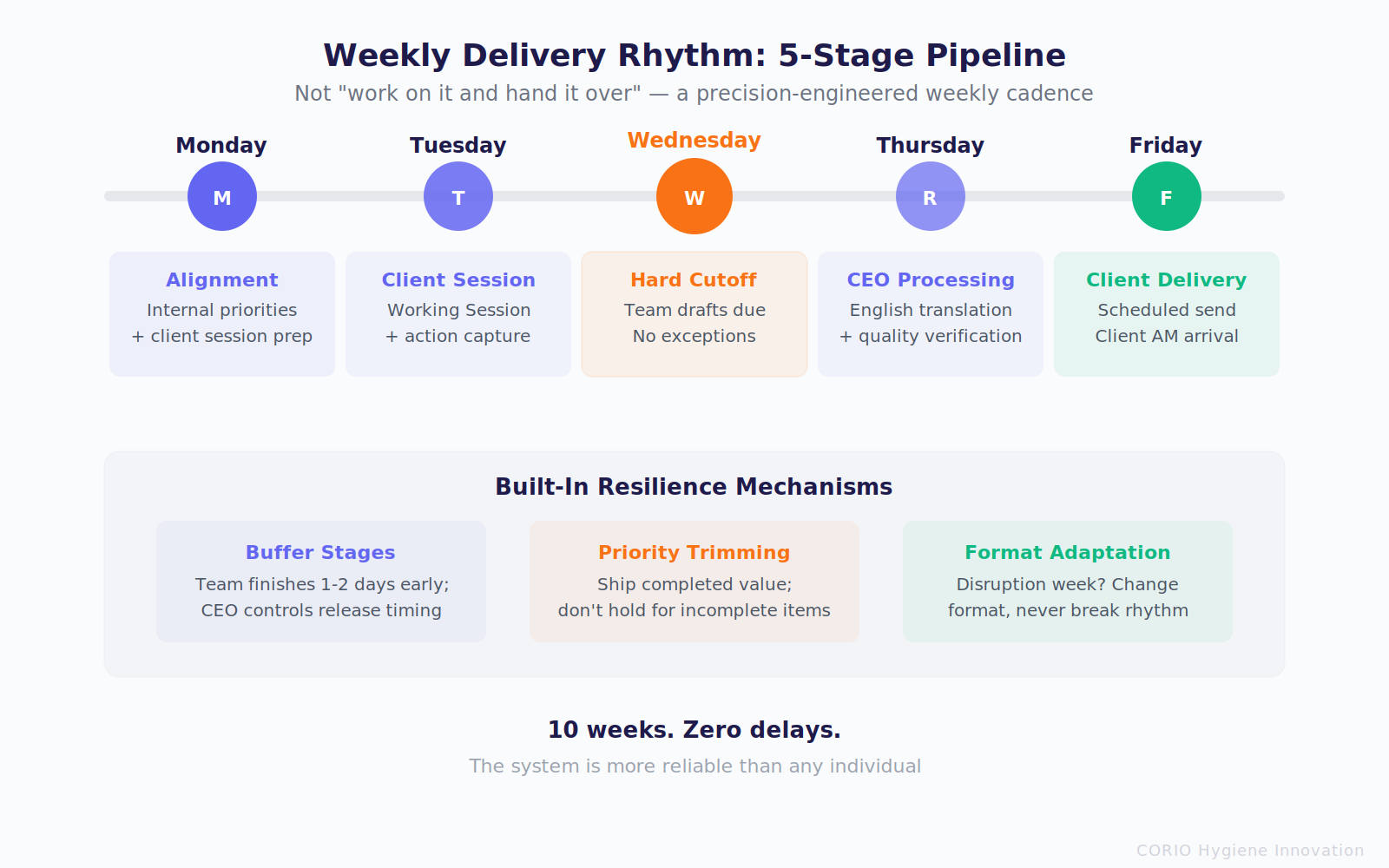
Monday is internal team alignment: reviewing client feedback signals from the previous delivery, confirming this week's deliverable priorities, and assigning specific tasks to the engineering and project tracks. Tuesday is the client working session: structured agenda, page-by-page discussion framework, immediate post-session action item confirmation. Wednesday is the hard cutoff for engineering drafts — reports, test data, and supplier progress must be completed, as this is the highest-pressure node in the entire pipeline. Thursday is final review and document processing: transforming engineering content into client-ready documentation, with final quality and sensitivity review. Friday is delivery — timed to arrive in the client's inbox at the start of their business day.
This pipeline ran for 10 weeks with zero delays. Not because there were no surprises — but because each stage's buffer was pre-engineered. Wednesday's hard cutoff gives Thursday a full day of processing margin; if one workstream misses Wednesday's cutoff, Thursday's review stage applies priority trimming (ship what is complete, flag the incomplete item with an estimated supplement date) — delivery is not "all or nothing" but "maximize delivered value."
The core design philosophy is "delivery frequency drives trust accumulation": weekly delivery creates four times more trust-building touchpoints than monthly delivery. Each on-time deliverable is a micro-scale capability proof — sustained by quality-over-speed discipline and producing a zero-delay 10-week record — 10 weeks × once per week = 10 capability proofs, which is more persuasive than a single report written over three months.