
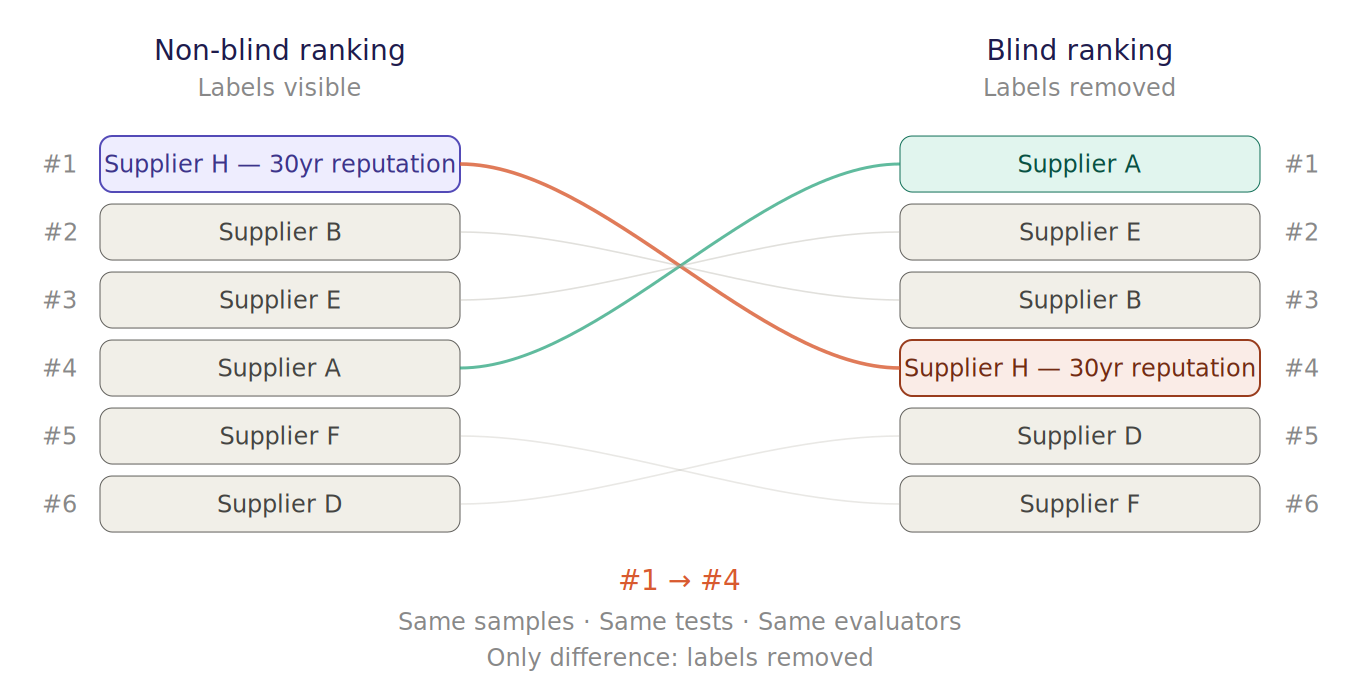
A supplier with over thirty years of industry reputation ranked first in every evaluation.
Every person involved — engineers, project managers, product leads — gave it top marks when they knew which sample came from which supplier.
Then we did something simple: removed the labels.
Same samples. Same test methods. Same evaluators. The only change was that evaluators no longer knew which sample belonged to which supplier.
The result: the thirty-year reputation supplier dropped from first out of eight to fourth.
Not second. Fourth.
The Reputation Halo
This isn’t a story about “that supplier was bad.” Their material was perfectly adequate — still in the top half of eight candidates. The problem wasn’t the supplier.
The problem was human cognitive architecture.
When you know Sample A comes from a company you respect, one you’ve worked with for years, one with excellent industry standing, your brain unconsciously awards it bonus points. Not deliberately. Not maliciously. Not even consciously. Psychology calls it the Halo Effect: a positive overall impression of an entity (“this is a good company”) radiates outward to influence judgment of every specific attribute (“so this sample must be better”).
The reverse is equally true: if a supplier is one you’re encountering for the first time, one whose name you don’t recognize, you’ll unconsciously hold their sample to a higher standard. Identical performance data gets interpreted as “reliable and consistent” when it comes from the known supplier, and “needs further verification” when it comes from the unfamiliar one.
Blind testing eliminates this halo.
Why Most Brands Don’t Blind-Test
Blind testing isn’t a new concept in consumer products — food, beverage, and personal care brands use it routinely to evaluate consumer preferences. But in supply chain material selection, blind testing is almost never used.
The reason isn’t technical difficulty — removing a label is a zero-cost operation. The reasons are three deeper resistances:
First, “we trust our suppliers.” Many brands have multi-year relationships with core suppliers. Proposing “I want to blind-test your samples alongside competitors” can feel like a signal of distrust. But this misunderstands the purpose of blind testing — it’s not distrust of the supplier. It’s correction for human cognitive bias. You trust the supplier’s intent and capability, but you should also verify outcomes through an objective method.
Second, “our team is professional enough — we don’t need blind testing.” The opposite is true. The more expert the evaluator, the more susceptible they are to the halo effect — because they have deeper knowledge of each supplier’s industry reputation, and that prior knowledge influences judgment more strongly in non-blind conditions.
Third, nobody knows how to operationalize it. The concept is simple, but the execution details in a material selection context — who codes the samples, what identifiers to use, how to define evaluation dimensions, how to analyze results — lack industry standardization. Most teams don’t refuse to blind-test; they just don’t know how.
Where Blind Testing Sits in the Screening System
Blind testing shouldn’t be your first evaluation step, nor your last. It has an optimal insertion point.
In an engineered supplier screening system, blind testing is typically the third layer — after qualification pre-screening and parameter verification, before commercial evaluation. We covered the complete screening funnel in a previous article. This piece zooms in on the one step most brands skip.
Layer 1 (Qualification pre-screening) answers “does the supplier qualify.” Do they have actual production capability in the target category? Export experience and compliance certifications for the target market? Compatible capacity scale? These are binary conditions — met or not met — that don’t require blind testing. In one project, we started with nearly fifty candidates and retained roughly twenty through qualification screening.
Layer 2 (Parameter verification) answers “are their claims accurate.” Do measured values match the supplier’s stated specifications? The core of this step isn’t evaluating performance quality — it’s verifying the accuracy of the supplier’s technical communication. Our approach: line up all candidates’ material samples on the same bench, same day, same operator, same method. In that project, three suppliers showed measured penetration speeds deviating more than 20% from their spec sheet claims — they were excluded not for poor performance, but for unreliable data. After parameter verification, roughly twenty became fewer than ten.
Layer 3 is blind testing — answering “how good, and how good relative to what.” At this point, every remaining candidate has passed “qualified” and “data trustworthy.” Now you need to determine: among these qualified suppliers, whose actual performance is best? Who provides the greatest differentiated advantage relative to your benchmark product (a competitor or your existing product)?
Layer 4 (Commercial evaluation) introduces cost, lead time, and supply risk. Only after blind-tested performance rankings are established do commercial dimensions enter the equation.
Why does this sequence matter? If you score cost and performance together at step one, a supplier with mediocre performance but very low price may receive the same composite score as a supplier with excellent performance at moderate price — your decision gets distorted by cost weighting. Technical screening first, commercial evaluation second — this sequence ensures the suppliers you ultimately select are technically optimal first, not just price-lowest.
How to Run an Effective Blind Test
The operation isn’t complex, but several details determine whether your blind test actually eliminates bias:
Coding protocol: One person who will not participate in evaluation handles coding — assigning each sample a random identifier (e.g., S-001 through S-008), recording the identifier-to-supplier mapping, and sharing it with no evaluator. The coder stays out of all evaluation discussions.
Benchmark samples: Beyond the candidates, include one or two benchmark samples — your currently used material and/or a market competitor. Benchmark samples receive anonymous codes as well. This lets you see not just the ranking among candidates, but where they sit relative to your “pass line.”
Pre-defined evaluation dimensions: Before testing begins, define evaluation dimensions and weights explicitly — not after results come in. Post-hoc dimension selection introduces another bias: you may unconsciously choose metrics that favor whichever candidate your gut preferred.
Multiple rounds: Each sample should be tested at least twice to confirm reproducibility. One round is a data point; two rounds is a credible trend. For absorbent product materials, go through at least the third insult — first-insult rankings and third-insult rankings are frequently inconsistent.
After the Blind Test
Blind testing gives you a clean, halo-free performance ranking. But it’s not the finish line.
The top three or four candidates from blind testing enter final commercial evaluation — where you consider cost, lead time, communication efficiency, and supply risk. A supplier with exceptional communication efficiency, even if not ranked absolute first on performance, may have lower total cost of ownership than the top-ranked candidate who requires three email rounds to clarify every technical point.
Ultimately, from nearly fifty starting candidates, four layers of screening yield three to four entering formal partnership evaluation. The funnel doesn’t “help you find good suppliers” — it eliminates the suppliers you shouldn’t waste time on, ensuring every minute and every dollar you spend goes toward validated candidates.
But across the entire funnel, blind testing is the step you should least afford to skip. Every other layer has alternatives — you can use different criteria for qualification, different methods for parameter verification, different models for commercial evaluation. But only blind testing can do one thing no other method can: remove your own cognitive bias from the decision.
This article is part of our supply chain methodology series. For a deeper look at how we define the pass/fail threshold before screening begins, see: [The Pass Line: Why You Need to Draw a Line Before You Start Sourcing]. For the complete screening funnel overview, see: [45 Suppliers, 4 Shortlisted: What a Real Screening Funnel Looks Like].