In consulting, "on-time delivery" is a baseline promise — but in practice, delays are the norm rather than the exception. Scope changes, incomplete data, delayed client feedback, internal review bottlenecks — each one is a reasonable excuse.
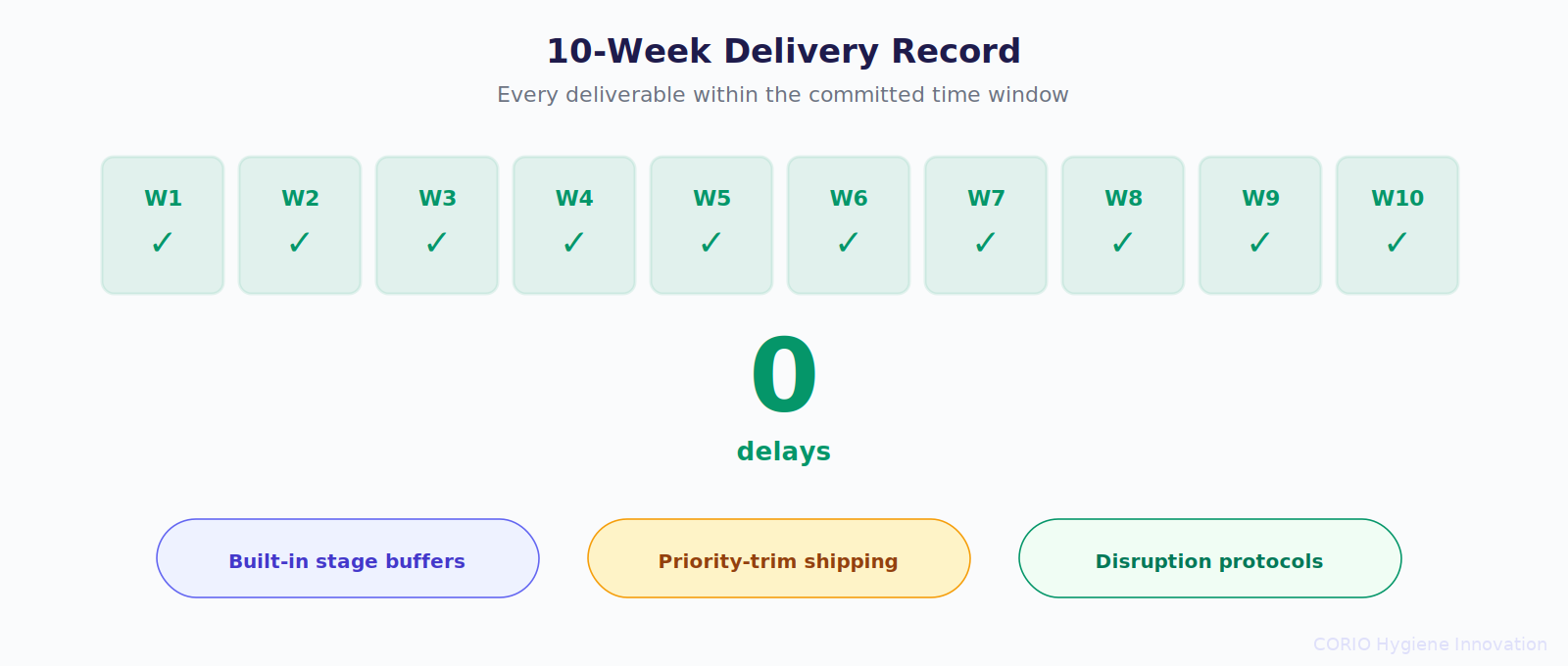
Over a 10-week pilot engagement, every weekly deliverable arrived in the client's inbox within the committed time window. Ten cycles, zero delays. This was not achieved through overtime or by sacrificing quality. It was engineered: built-in buffers between production stages (detailed in the weekly delivery rhythm design), a priority-trimming mechanism that ships completed value rather than holding everything for a single incomplete item, and contingency protocols that adapt delivery format without breaking delivery rhythm — even during disruption weeks such as industry exhibitions.
For the client, the value of a zero-delay record extends beyond reliability. It established a predictable information rhythm. When the client knew that every Friday morning her inbox would contain an update, she could align her own decision cadence to that rhythm. Predictability reduced the cognitive overhead of the engagement — she never needed to ask "when is this week's report arriving."
That absence of a question is the strongest operational signal. When a deliverable is so consistently on time that the client stops thinking about timing altogether, the delivery system — underpinned by the same quality-first discipline applied to every deliverable — has achieved its design intent: removing friction from the client's workflow rather than adding to it.