Traditional supplier management has two extremes: one is "find one and lock in" — simple but fragile, with no fallback when the supplier underperforms; the other is "find all suppliers from day one" — ideal but unrealistic, because in the early project stages you do not yet know what you truly need.
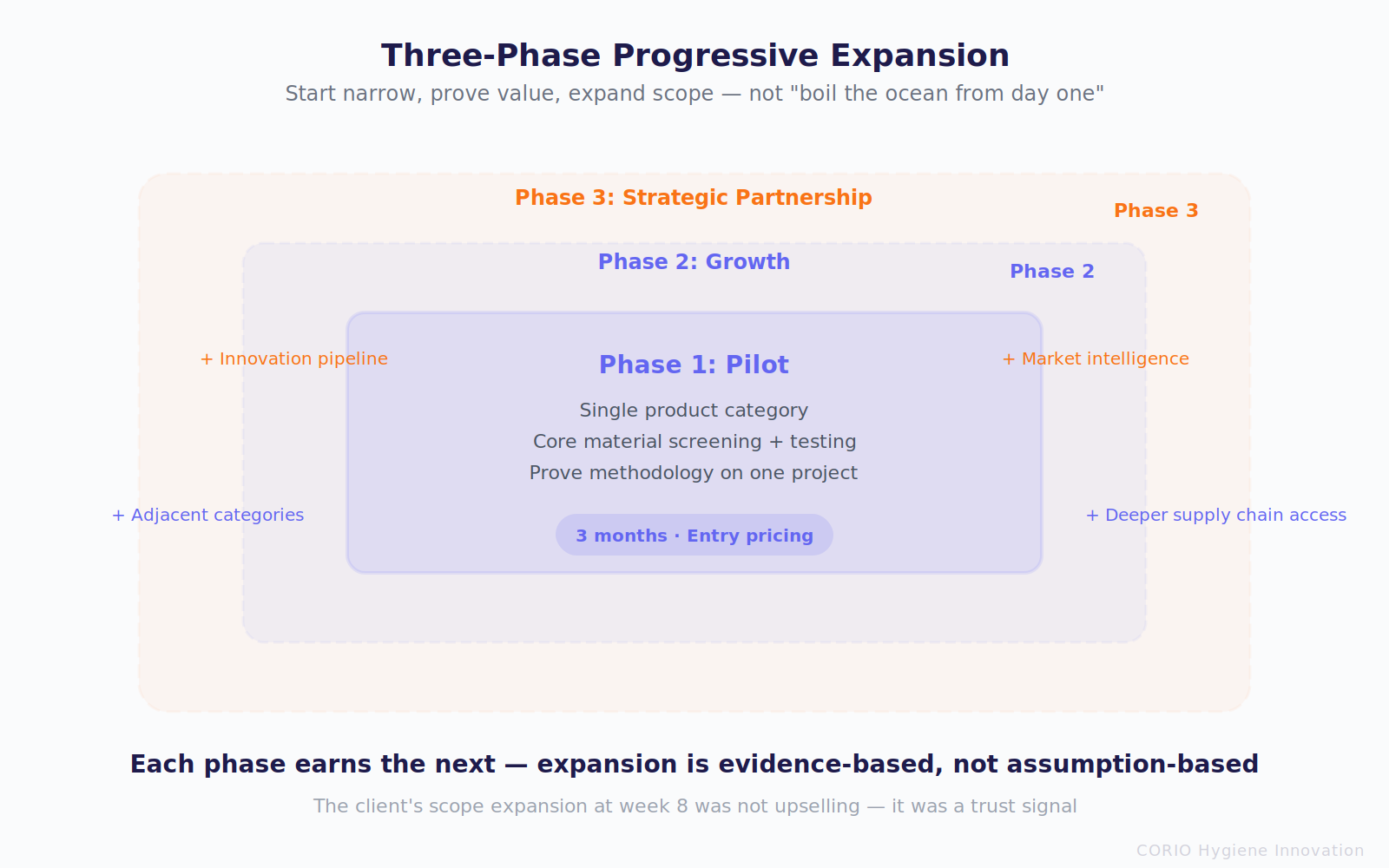
We designed a three-phase progressive expansion model, with each phase having distinct objectives and resource allocation.
Phase 1 (Minimum Viable Set): the goal is "enough to start." For each material category, lock in 1–2 suppliers who can immediately provide samples — not pursuing the best, pursuing speed. The core of this phase is preventing the client's product development from stalling due to supplier screening. At this stage, over half of suppliers are eliminated in the first screening round — what remains is not the best, but "what can move right now."
Phase 2 (Competitive Alternatives): the goal is "having options." Building on Phase 1, expand the network to establish 2–3 alternatives for each critical category. The tool for this phase is multi-method horizontal evaluation — comparing not just pricing but performance under the same testing protocol. The industry exhibition became an accelerator for this phase — face-to-face engagement completed in one day what remote mode would have taken weeks.
Phase 3 (Strategic Deepening): the goal is "retention." Enter deep collaboration with locked-in primary suppliers — including customized prototyping, intellectual property management, batch consistency verification, and long-term capacity reservation. Suppliers at this stage are no longer "replaceable options" but "part of the product architecture."
The three phases are not strictly linear — they overlap and loop back. Phase 2 evaluation results may overturn Phase 1 selections; issues discovered during Phase 3 deep collaboration may trigger supplementary Phase 2 screening. Flexibility is a design feature, not a bug — informed by geographic supply landscape analysis and validated through hybrid screening.