When you are evaluating dozens of material samples from multiple suppliers simultaneously, the biggest risk is not a testing error — it is a mix-up. "Is this the 18gsm from Supplier A or the 22gsm from Supplier B?" Once that question arises at the test bench, every data point collected before it becomes unreliable.
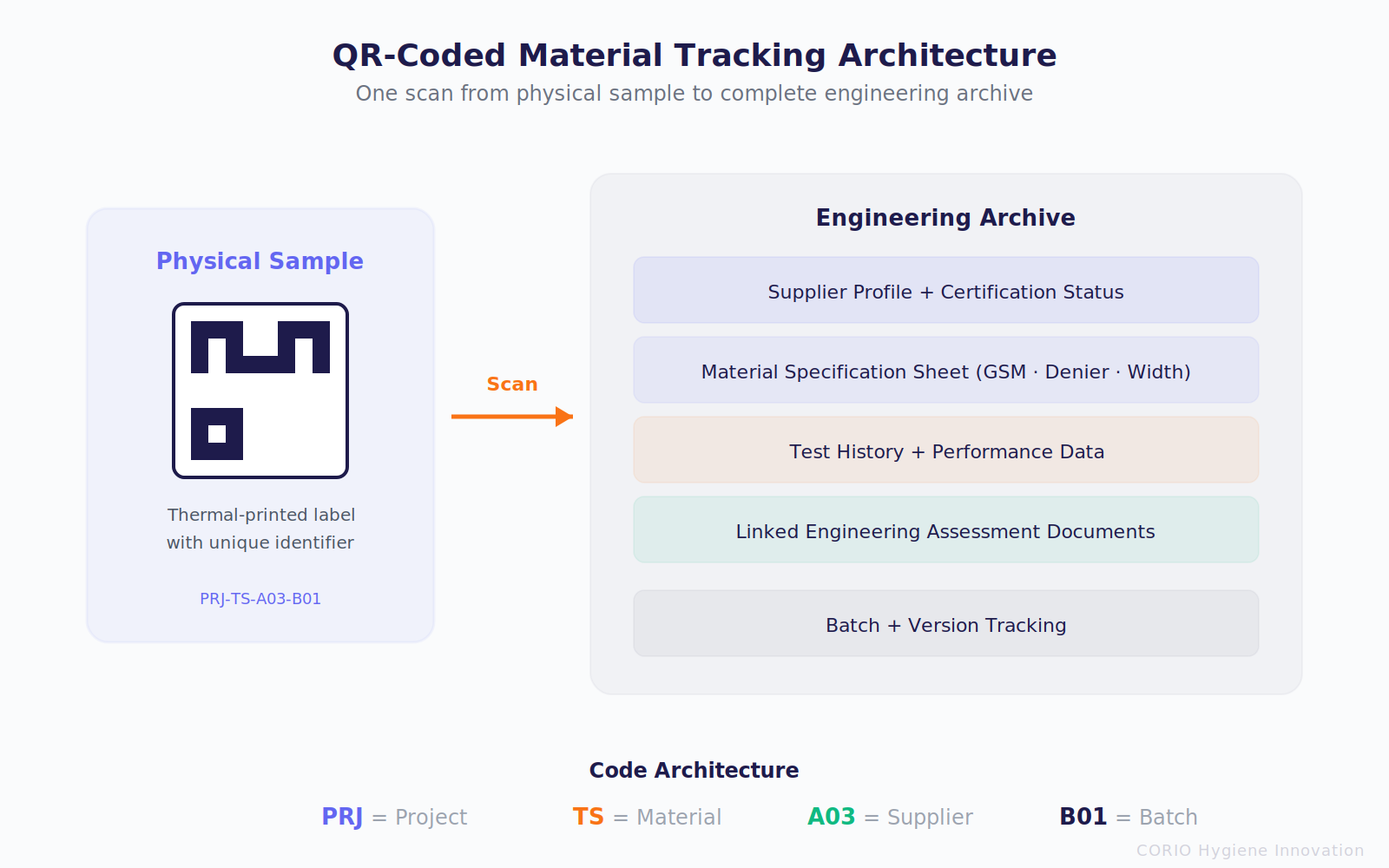
We built a coded tracking system for every raw material sample and every handmade prototype. Each sample carries a thermal-printed label containing a unique identifier (structured by project, material category, supplier, and batch), key physical parameters (basis weight, denier), and a QR code. Scanning the code and entering a password retrieves the sample's complete archive — supplier profile, material specification sheet, test history, and linked engineering assessment documents.
The system proved most valuable during an industry exhibition — one of the key moments in the client trust evolution: when the client needed to compare two backsheet materials on the exhibition floor, she did not need to flip through folders or recall "which supplier was this from" — one scan delivered the full profile instantly. Coded samples were taken back to the client's US office as reference materials (extending the value of the pre-contract technical preview) — each traceable through its identifier to a complete engineering record — the same depth of preparation behind our pre-contract technical previews.
This is not surface-level labeling. The underlying architecture is a structured material information taxonomy — each code's prefix identifies the project, middle segments identify material category and supplier, and suffix identifies batch and version. The distance between "a piece of nonwoven in your hand" and "the complete engineering archive in the database" is exactly one scan.