Most competitive analyses are produced once at project kickoff, then filed away. Three months later the market has shifted, the analysis is outdated — but no one updates it, because it was designed as a "one-time deliverable."
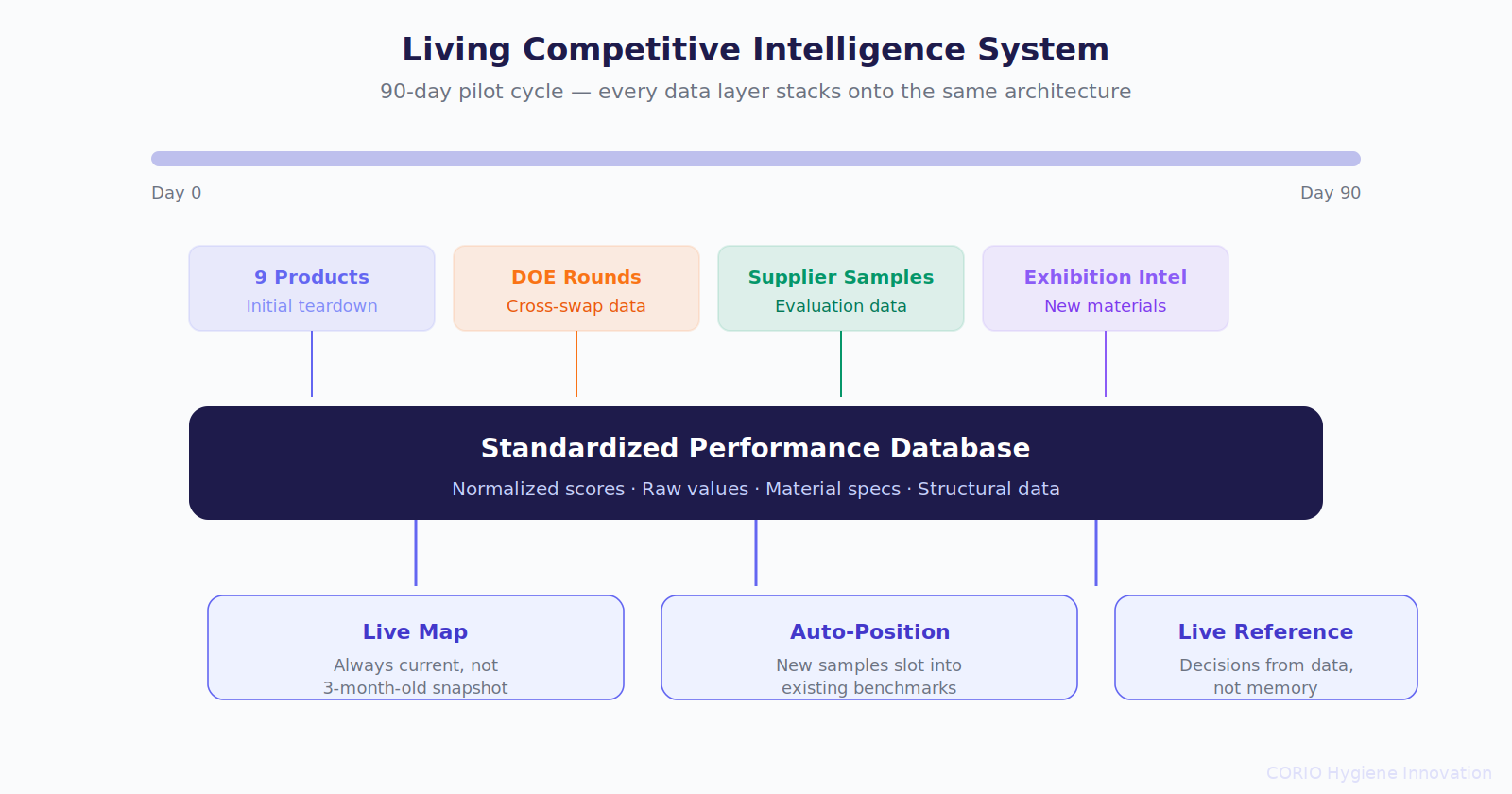
We designed competitive intelligence as a continuously operating system, not a static document. The system's core is a standardized product performance database where all teardown and test data is entered in a uniform format — normalized scores, raw test values, material specifications, structural characteristics. When a new test round is completed (whether a competitor update, a supplier sample, or the client's own prototype), new data automatically enters the same comparison framework (the same architecture used in competitive positioning maps and dynamic testing models).
This design produces three direct benefits: first, the competitive map is "alive" — each update reflects the latest market state rather than a three-month-old snapshot; second, new supplier samples can be positioned directly against competitive benchmarks within the same coordinate system — no need to rerun competitive testing to establish a comparison baseline; third, the client team has a continuously updated reference framework for every product decision discussion — decisions are based on a live database, not remembered data.
Ninety days is one pilot cycle. Within that period, the database grew from zero through 9 products' initial teardown, multiple rounds of DOE test data, supplier sample evaluations, and new material information collected during an industry exhibition — each data layer stacking onto the same architecture.