Testing all possible material combinations exhaustively would require hundreds of samples and weeks of time. We designed a progressive validation protocol to extract maximum decision information from minimum resources.
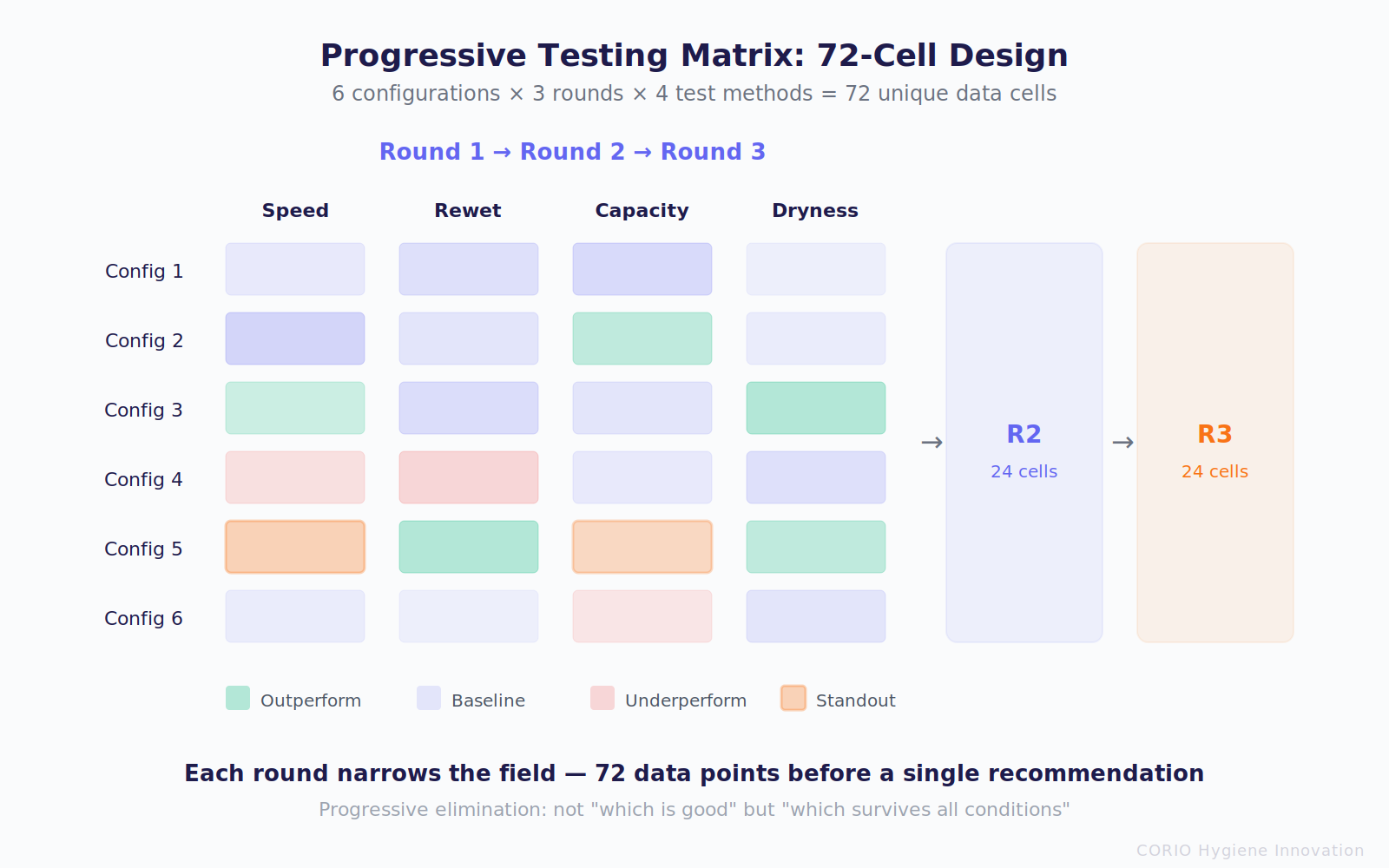
Phase 1 (Round 1): N=1 rapid screening of 6 cross-swap configurations, identifying trend directions within 48 hours. Phase 2 (Round 2): N=2 confirmatory testing on the strongest-trending configurations, eliminating single-test flukes. Phase 3 (Round 3): N=5 formal validation, simultaneously deploying four independent test methods — triple-pressurization protocol, national standard absorption speed, total capacity and retention rate, and 12-hour overnight simulation — cross-verifying the robustness of conclusions.
Cross-round CV (coefficient of variation) analysis confirmed data reproducibility: key metrics maintained consistent trend directions between Round 2 and Round 3, though absolute values showed expected variation from topsheet conditions and sample assembly tolerances.
Ultimately, the 72-cell data matrix compressed to one clear conclusion: Core E consistently outperformed Core C across all test methods and all topsheet conditions — not a method-specific fluke, but a structural advantage.