
During raw material evaluation, one ADL candidate’s test data deviated significantly from the expected baseline — not by a small margin, but by more than fourfold on the key performance indicator. The instinctive first response is usually “the test was probably wrong.”
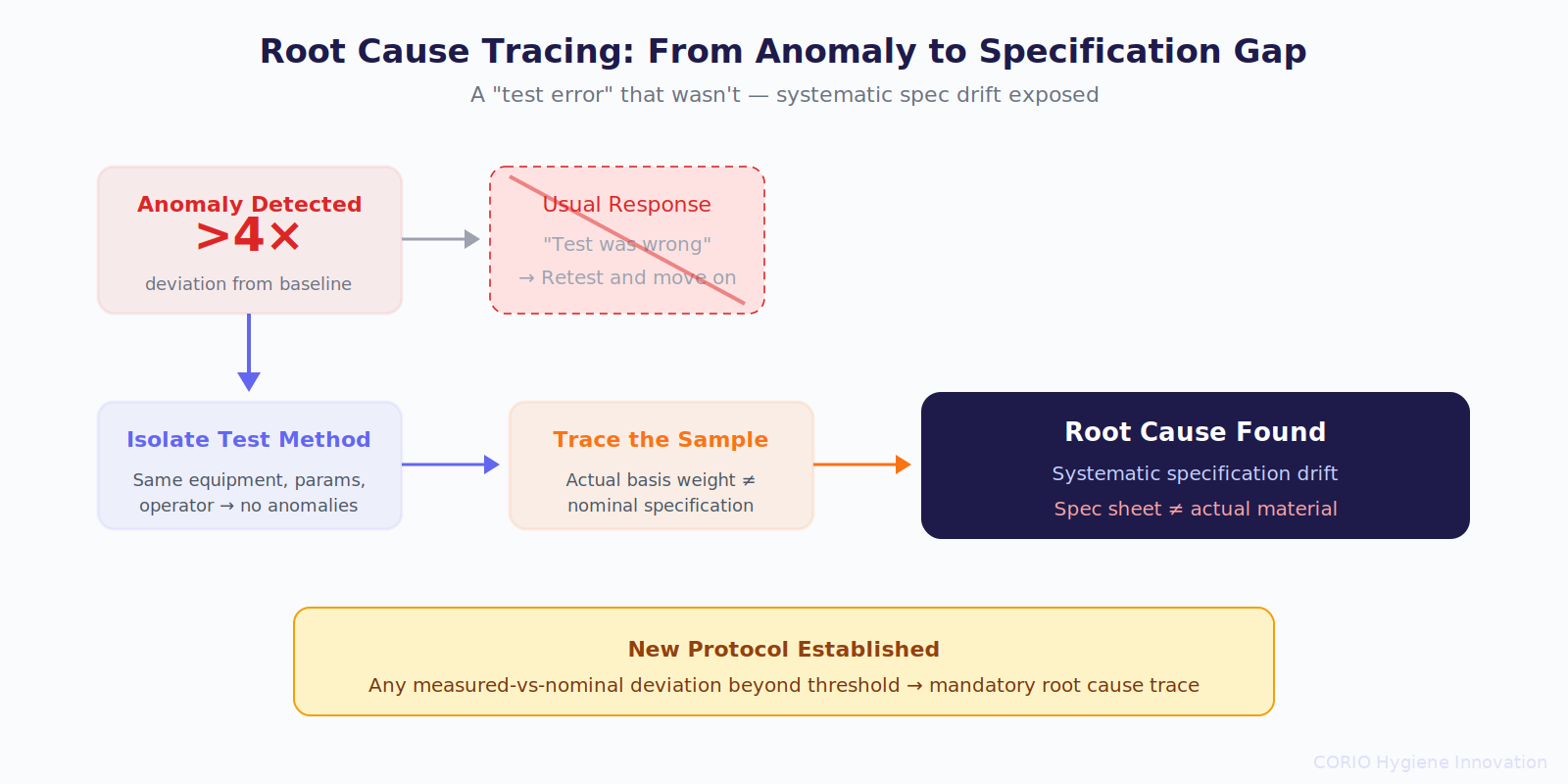
We did not simply retest and move on. Instead, we initiated a root cause tracing protocol (one layer of our three-source cross-validation methodology): first isolating the test method variables (same equipment, same parameters, same operator — no anomalies on the testing side), then tracing the sample itself. The material’s actual basis weight was found to be significantly below its nominal specification.
The implication: the parameters on the supplier’s specification sheet did not match the material actually delivered. This was not normal manufacturing fluctuation — it was systematic specification drift. Had we accepted the “test anomaly” explanation and discarded the data point, the client could have unknowingly selected a material supplier whose actual performance fell far short of its documented promises.
The value of root cause tracing extends beyond explaining a single anomalous number. It exposed a supplier management risk: a trust gap between nominal specifications and actual deliveries. This finding was incorporated into all subsequent supplier evaluations as standard protocol — any deviation between measured data and nominal specification beyond a defined threshold must be traced to root cause, never dismissed as “test error.”