The consulting industry's standard pre-contract offering is a credentials deck and case study collection — "here is what we have done for others." The implicit message is: trust our past, then pay us to do it for you.
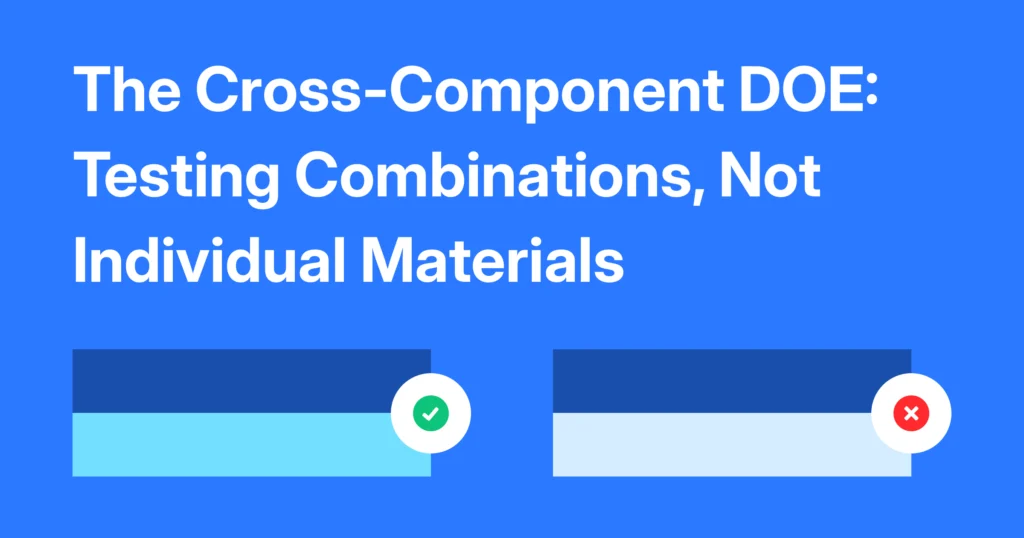
We took a different path. Before any contract was signed, we completed a full cross-component DOE interaction test — disassembling the client's product and a competitive benchmark, coding material layers, cross-recombining into 6 configurations, and running two rounds of validation. The output was not a teaser or a preview — it was a complete technical report with precise data and engineering conclusions that the client could immediately apply to product decisions.
The formulation discovered in this pre-contract work (DBE) did not just prove our testing capability — it created a result the client could not ignore. When the client saw her own product's performance mapped against the DOE matrix, the question shifted from "should we work with this company" to "we need them to help us solve this problem." The pre-contract deliverable did not close a sale — it created a need.
This is fundamentally different from a "free trial" or a "sample project." A free trial shows process. A complete pre-contract engineering task shows judgment — what to test, how to structure the comparison, and how to translate raw data into a strategic conclusion. The quality gap between the two is what separates a credentials pitch from a capability proof.