Most product development teams treat deadlines as a single number: you either hit it or you miss it. This team approaches time differently — every deadline gets decomposed into three layers before any work begins.
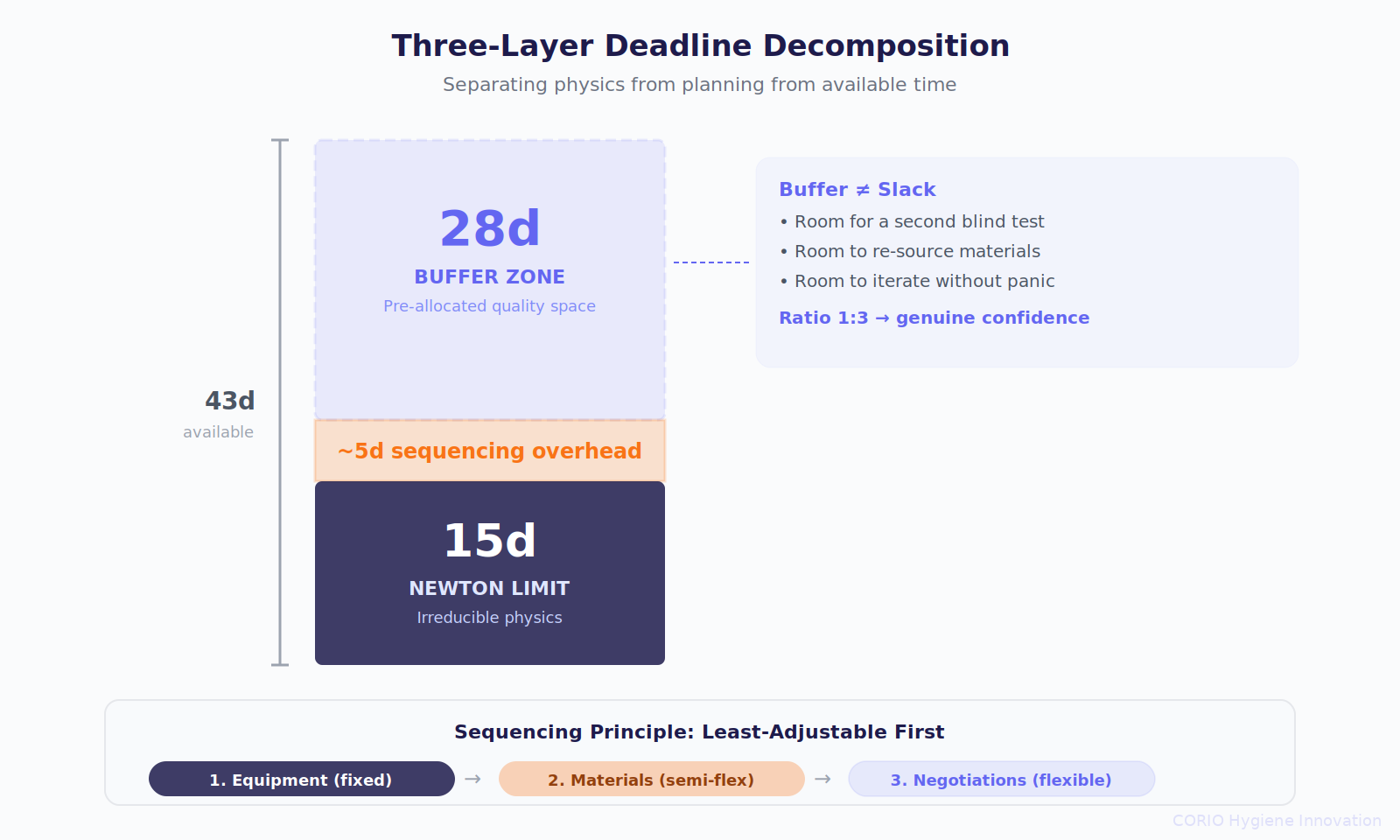
The first layer is what they call the "Newton Limit" — the absolute theoretical minimum assuming zero friction, zero waiting, zero rework. Every task stripped to its physics: if a supplier needs 7 days to ship samples, that's 7 days regardless of how many people you assign. If a machine test takes 1 day, no meeting can compress it further. This layer is non-negotiable.
The second layer is the operational ceiling — real-world sequencing with task dependencies, parallel tracks identified, and known constraints (holidays, equipment availability, approval gates) mapped in. This is what a good project manager produces.
The third layer is the actual available window — the hard external deadline minus the operational ceiling. The gap between layer two and layer three is the buffer. But critically, this buffer is not slack time. It is pre-allocated quality space: room for a second blind test if the first one yields ambiguous results, room to re-source a material if the first supplier's sample disappoints, room to iterate without panic.
In one engagement, this framework was applied to a sample development program with a fixed external product review deadline. Layer one: 15 days of irreducible physics. Layer two: approximately 20 days with realistic sequencing. Layer three: 43 days available. The resulting 28-day buffer — a ratio of nearly 1:3 between minimum work and available time — meant the team could commit to the deadline with genuine confidence rather than optimistic hope.
The framework also changed how work was sequenced: the team prioritized tasks by adjustability. Equipment constraints (fixed) were resolved first. Material selection (semi-flexible) came second. Supplier negotiations (most flexible) came last. This "least-adjustable-first" principle prevented the common failure mode where flexible tasks consume the schedule and inflexible ones create last-minute crises. In practice, this framework produced a 24-day compressed timeline and informed critical path decomposition across the engagement.