"This backsheet doesn't feel right" — client feedback typically ends there. The product manager notes it, relays it to the supplier, the supplier says "we'll improve it." Six months later the problem persists. Because "doesn't feel right" is not an actionable engineering instruction — it is the mixed perception of at least three independent variables.
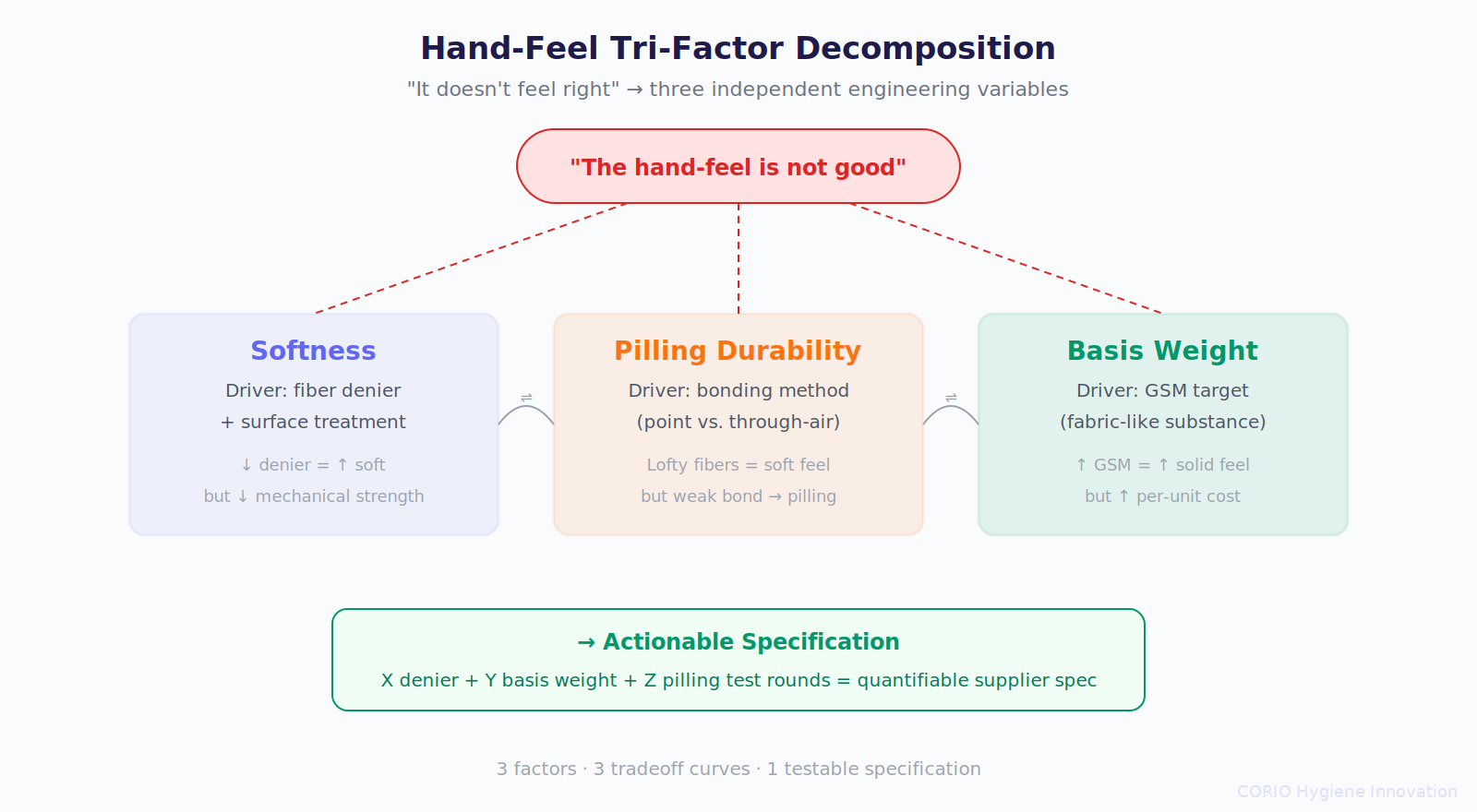
We decomposed backsheet hand-feel into three engineering factors: softness (determined by fiber denier and surface treatment — lower denier means softer, but mechanical strength decreases accordingly); pilling durability (determined by fiber bonding method — this is precisely where highloft's structural defect lies, with fibers that are lofty but weakly bonded, inevitably loosening under wear friction); and basis weight (affecting perceived substance and manufacturing cost — higher basis weight provides a fabric-like "solid feel" but increases per-unit cost).
The three factors have engineering tradeoff relationships: extreme softness typically means lower pilling durability; higher basis weight provides better perceived substance but increases cost. Understanding these tradeoff curves is what transforms "I want it to feel good" into an actionable specification: "X denier + Y basis weight + Z rounds of pilling test pass."
At the industry exhibition, we prepared multiple TABCW samples at different basis weights and processing parameters for side-by-side tactile comparison. When the three factors were separated and experienced individually, "doesn't feel right" became a set of quantifiable — and sometimes constraint-triggered —, benchmarkable parameters that could be written directly into supplier specifications.