The diaper and pull-up market contains three fundamentally different core architecture strategies, each representing a different engineering philosophy and commercial tradeoff.
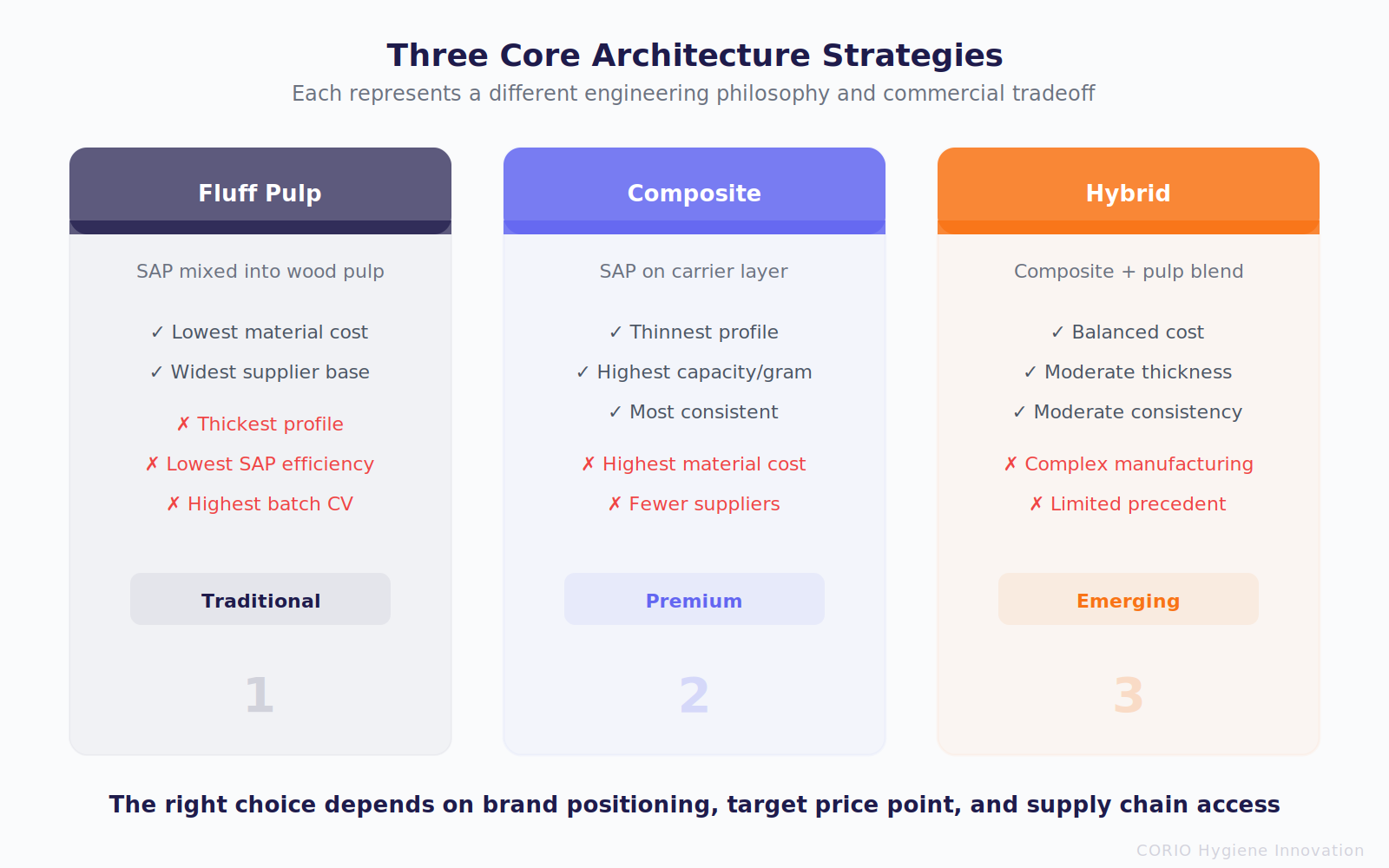
Fluff pulp type (SAP mixed into wood pulp fibers) is the traditional approach — low material cost, mature manufacturing processes, but fibers occupy substantial volume, resulting in heavy and thick products. Our testing data showed total absorption of approximately 474g with a retention rate of approximately 79%. Composite type (SAP sandwiched between multi-layer nonwoven carriers) achieves higher performance in a more compact structure — total absorption of 771g (over 30% above fluff pulp), retention rate of approximately 87%, at nearly identical product weight. Proprietary type (using a closed architecture design protected by intellectual property) demonstrates unique performance characteristics under multi-dose conditions — but this architecture is not replicable or commercially available.
The gap between these three is not "slightly better or slightly worse" — it is a structural ceiling difference. The physical limits of fluff pulp (fiber swelling displacing SAP space) mean that no amount of optimization can approach the composite type's performance upper bound.
For the client, this was not "choose the cheap one or the expensive one." Core architecture is the engineering foundation of brand positioning — if the ceiling is too low, all subsequent material optimization is spinning within a constrained space. Understanding the structural boundaries of all three strategies is the prerequisite for making the right choice.