
There is a fact rarely discussed openly in the industry: different test protocols — varying in equipment, liquid delivery method, pressure application, and load weight — can produce significantly different results when measuring the same product — the difference is not 5% or 10%; on certain metrics it can reach an order of magnitude.
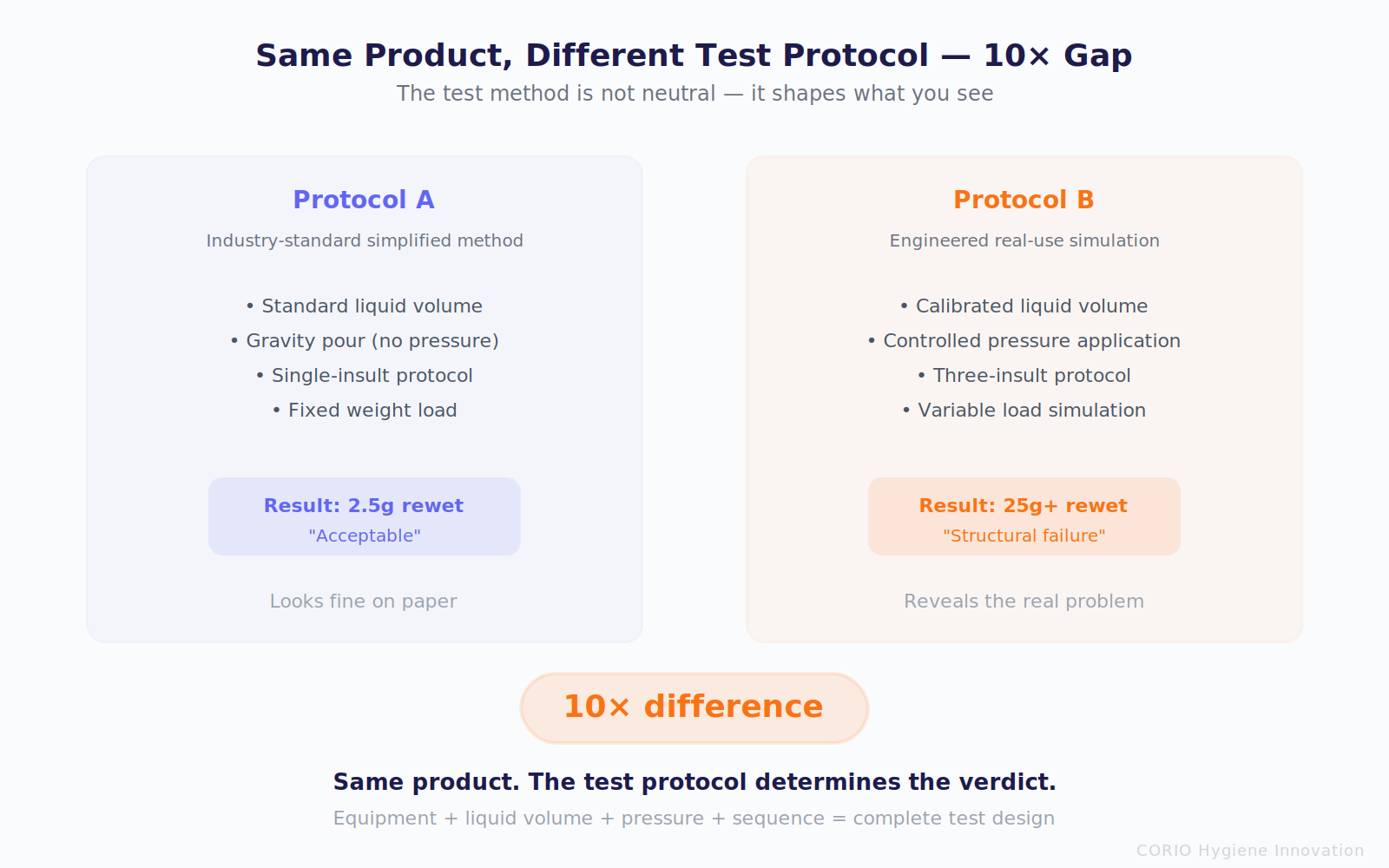
We conducted a systematic benchmark comparison of mainstream diaper performance testing equipment — enabling both dynamic testing models and methodologies transferred from adjacent industries: from basic liquid delivery methods (free pour vs. point delivery vs. pressurized delivery) to measurement sensor sensitivity ranges, to how fixtures apply pressure to samples — every variable affects the final number. A basic absorption speed tester and a professional constant-pressure testing system can produce readings differing by 10× when measuring the same product's absorption speed — not because the product is different, but because the test conditions are different.
What does this mean? If a client compares data measured on Equipment A against competitive data measured on Equipment B, the conclusion may be entirely wrong. Data comparability depends on test condition consistency, and the industry has no mandatory unified equipment standard.
Our response strategy has three layers: first, all horizontal comparison data must be tested on the same equipment with the same parameters — ensuring apples-to-apples; second, when referencing external data, we annotate equipment type and test conditions — letting the client know the "coordinate system" of that number; third, we maintain an internal equipment baseline cross-reference table — providing a validated conversion framework when cross-equipment data comparison is necessary.