The materials the client needed — cotton topsheet, TABCW backsheet, ADL — come from three completely different supply paths. On the surface, this is a procurement problem. We discovered a deeper risk dimension: formulation transparency.
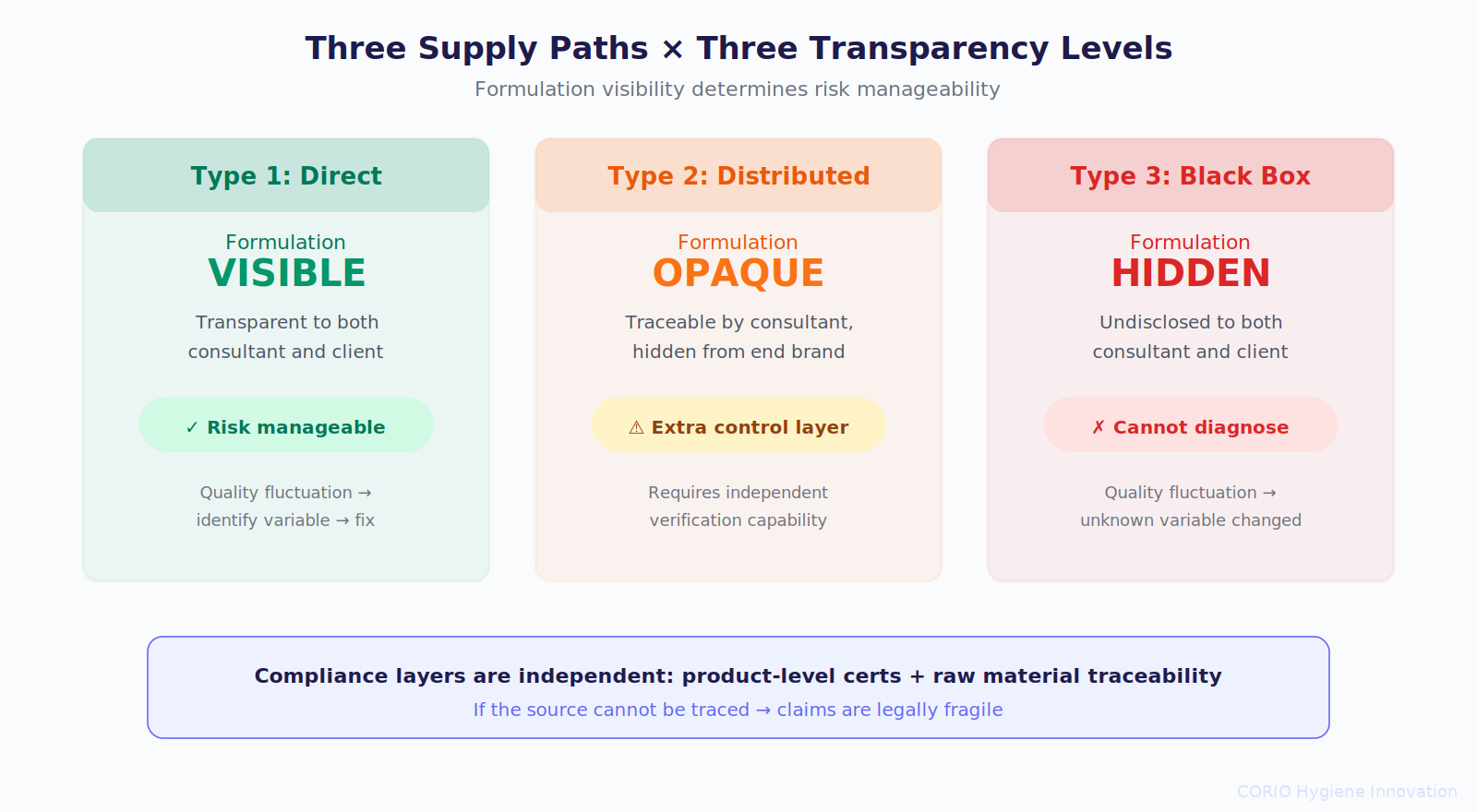
The three paths carry different risk levels: Type 1 — direct material supplier, formulation transparent to both the consulting team and the client, risk manageable. Type 2 — material supplied through distributors or processors, formulation opaque to the end brand but traceable by the consulting team — requiring an additional control layer. Type 3 — integrated suppliers providing “black box” materials, formulation undisclosed — meaning that if quality fluctuations occur, you cannot even identify which variable changed.
The compliance framework (extending from upstream supply scarcity analysis through structured supplier screening) must also be layered: at the finished product level, certifications (such as organic cotton, Cotton LEADS) and retail channel compliance (such as retailer-specific testing requirements); at the raw material level, transaction certificates (TC) and supply chain traceability — two independent systems, both non-negotiable.
For the client’s core claim of “100% cotton” — we identified a critical risk: if the cotton source cannot be traced to the growing stage, a “100% cotton” claim is legally fragile. The cost difference between Identity Preserved (IP) and non-IP supply chains is significant, but the compliance risk difference is larger.