The diaper industry's testing methodology has remained largely unchanged for two decades — the same liquid volumes, the same test areas, the same one-or-two-dose cycles. These methods are "adequate," but they were designed in an era of simpler product forms and material technologies. When composite cores, functional ADLs, and 100% cotton topsheets enter the market, the old methods' blind spots become exposed.
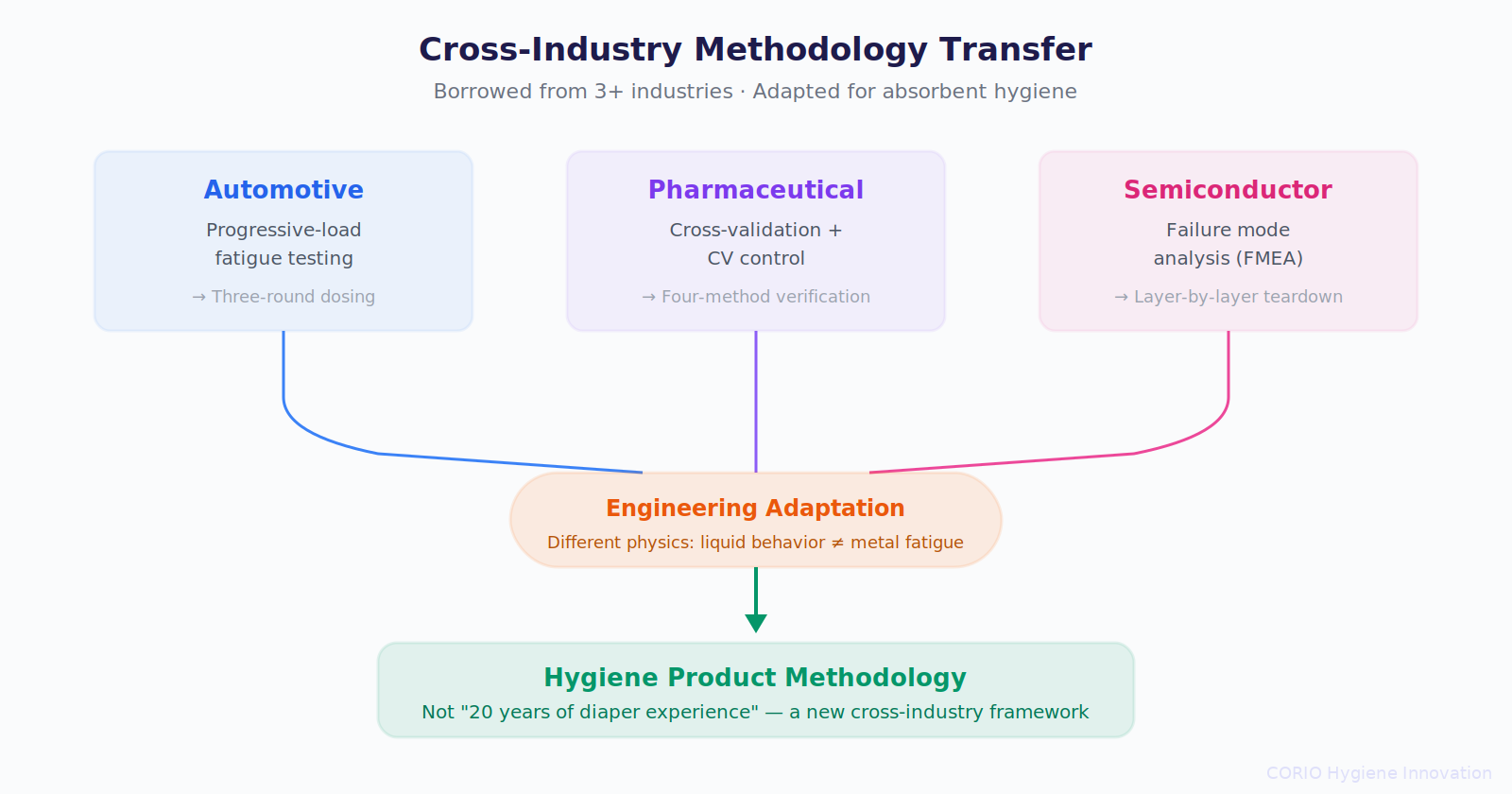
We did not invent new methods from scratch. We borrowed core principles from three different industries' testing methodologies: from the automotive industry, the concept of "progressive-load fatigue testing" (incrementing from small loads to the limit — our three-round progressive dosing protocol follows exactly this logic); from the pharmaceutical industry, "cross-validation and coefficient of variation control" (multi-method cross-confirmation + CV analysis to exclude random error — our four-method verification system); from the semiconductor industry, the "failure mode analysis" framework (systematically decomposing each failure point's root cause — our layer-by-layer teardown methodology).
After borrowing, each principle required engineering adaptation for absorbent hygiene products — the physics of liquid behavior (viscosity, surface tension, penetration rate) are completely different from metal fatigue or drug metabolism, so formulas cannot be directly transplanted. But the underlying methodological architecture — "progressive validation," "cross-confirmation," "failure mode analysis" — is cross-industry universal engineering thinking.
For the client, this means they are not receiving "20 years of diaper industry experience accumulation" — everyone in this industry has that. They are receiving "a new methodology forged from three industries' verification frameworks" — something almost no one in this industry has done before.