Traditional product development timelines are sequential — and traditional sampling logic compounds the problem. Most teams either combine appearance and performance evaluation into a single sample run (saving cost but delaying everything until all parameters are finalized), or use fragmented samples that show different features on separate pieces (saving cost but destroying the holistic product experience). Both approaches sacrifice either time or quality.
We made three engineering decisions that compressed the timeline without sacrificing either.
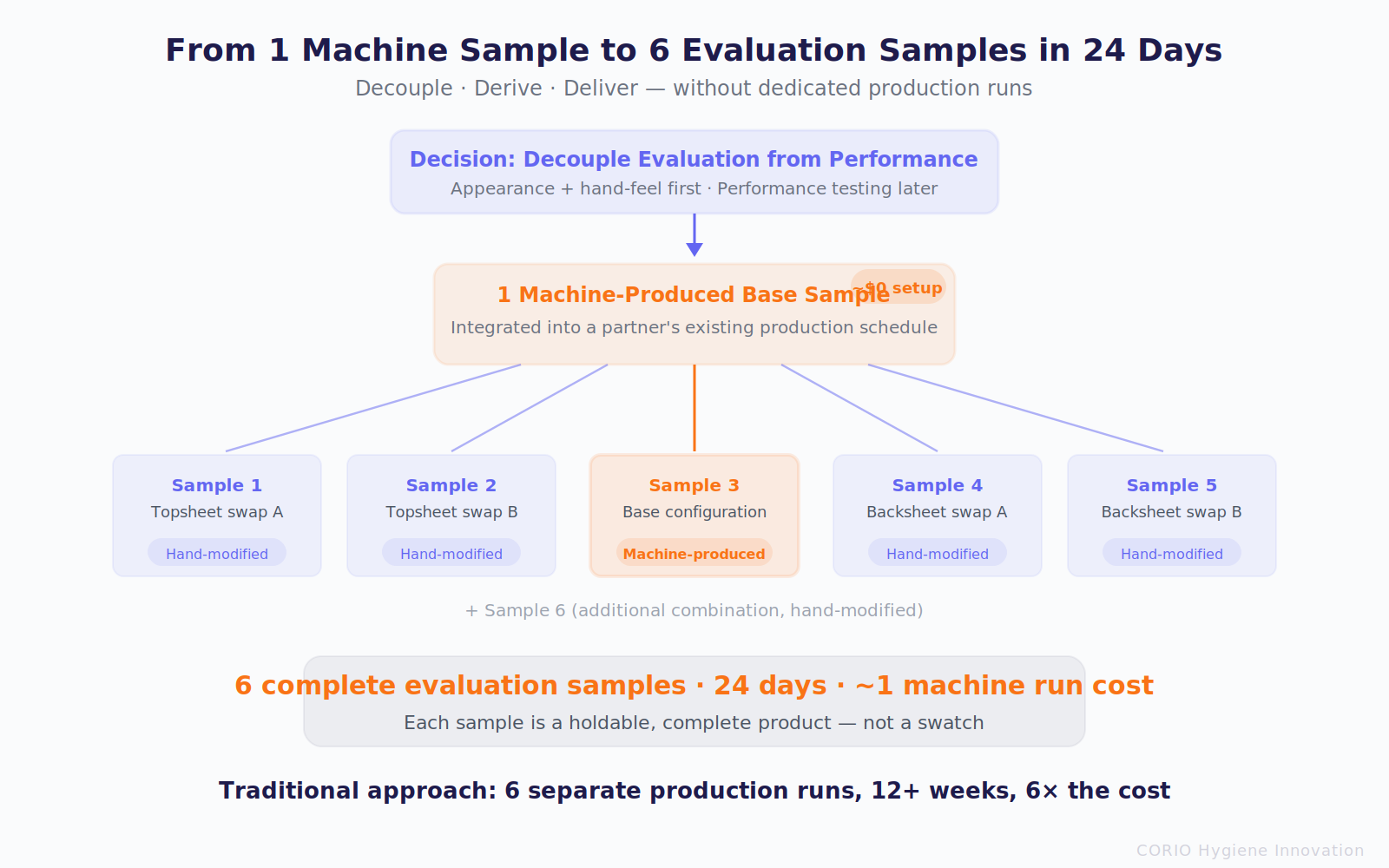
First, we decoupled evaluation from performance. The client needed samples for a retail channel review — appearance and hand-feel, not absorption data. By separating the evaluation sample track from the future performance sample track, we eliminated the dependency that forces most teams to wait until all specifications are locked before producing anything physical.
Second, we designed a hybrid machine-plus-handmade sampling architecture. Of the six material combination samples delivered to the client, only one was produced on a converting line. The other five were hand-engineered from that base sample — selectively replacing the topsheet or backsheet layer to demonstrate different material combinations. Each sample was a complete, holdable product — not a swatch book. Six configurations delivered at roughly the cost of one machine run.
Third, even the single machine-produced sample was not a standalone production request. During supplier coordination, we identified that one converting partner had an upcoming production run with specifications closely matching our target. We integrated our sample into that existing schedule — one additional configuration added to a run that was already happening. No dedicated machine setup, no standalone minimum order.
The result: 24 days from requirement confirmation to six complete evaluation samples in the client's hands — each demonstrating a distinct material combination for appearance and hand-feel assessment. The client could physically compare options side by side, as complete products rather than isolated material swatches. A conventional approach (contrast with the three-layer time margin methodology and critical path decomposition) to the same scope would have required 12 or more weeks and significantly higher sampling costs.