Industry-standard testing is typically conducted under static conditions — liquid is poured at a standard volume into a fixed product sample, and absorption speed and rewet are measured. These data points are repeatable and horizontally comparable — but they describe an idealized scenario where the baby is completely still.
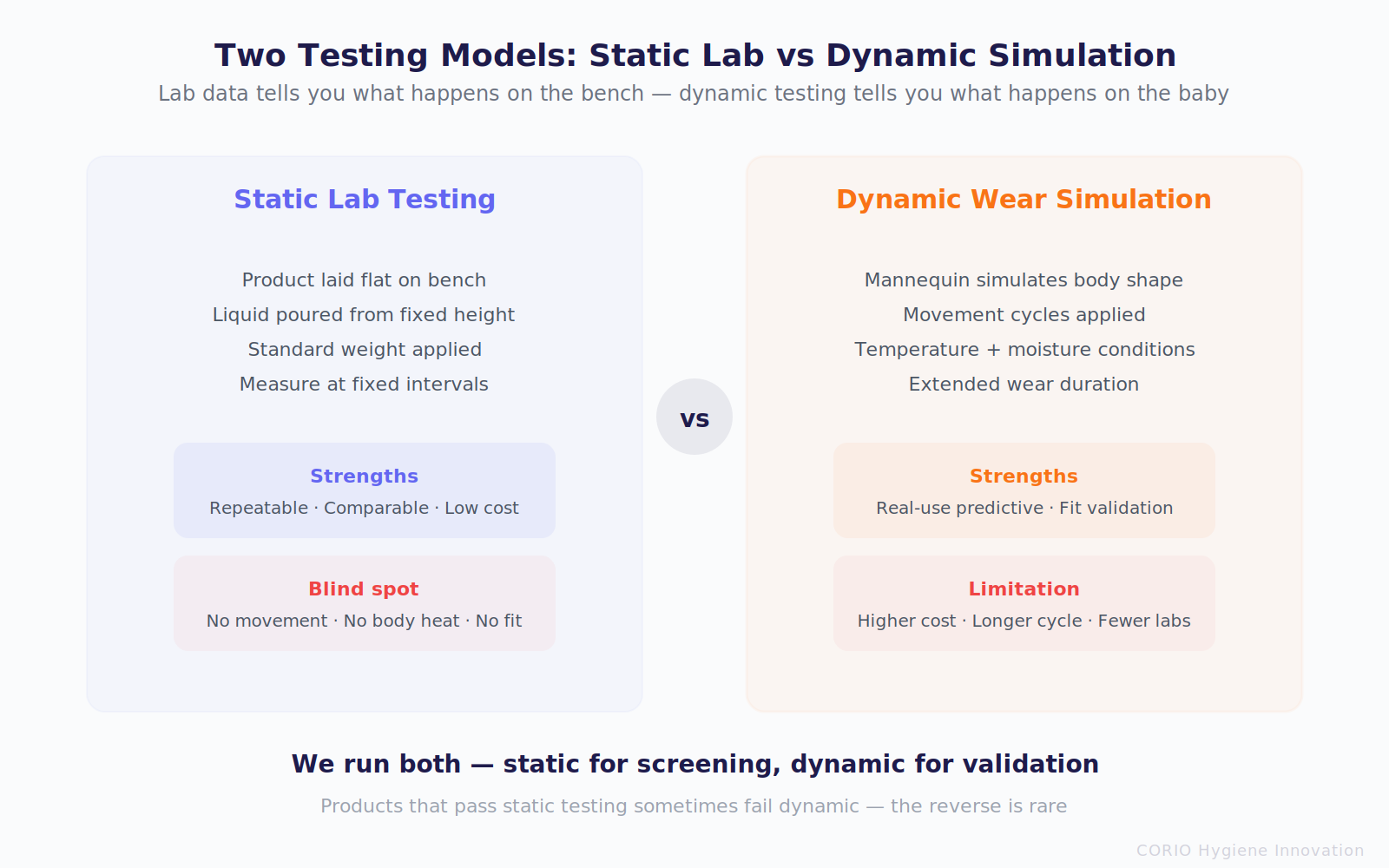
Real wear scenarios are dynamic: the baby crawls, rolls, runs. Liquid distribution is affected by body position and movement patterns. The elastic system continuously stretches and recovers. Leg cuff and waistband fit fluctuates with posture in real time. A product with excellent static test data may experience side leakage in dynamic wear due to poor leg cuff conformity.
We established two parallel testing models. Static laboratory testing is used for material-level horizontal comparison and performance baseline establishment — standardized conditions ensure data comparability. Dynamic wear simulation uses standard-sized mannequins to evaluate fit, coverage, and dynamic leak protection — testing elastic system response across different body positions.
A key finding: in the pull-up category, elastic system contraction alters the liquid distribution pattern across the core surface, causing static tests to systematically overestimate certain products' dryness performance. Identifying this "test artifact" and applying engineering calibration — performed on benchmarked testing equipment and verified through progressive multi-round protocols — rather than taking lab data at face value as product performance — is the critical bridge from data to decision.