The client’s existing product used a spunbond backsheet, and consumers had reported surface pilling under wear friction. The team initially assumed this was a manufacturing quality control issue — switching suppliers would solve it.
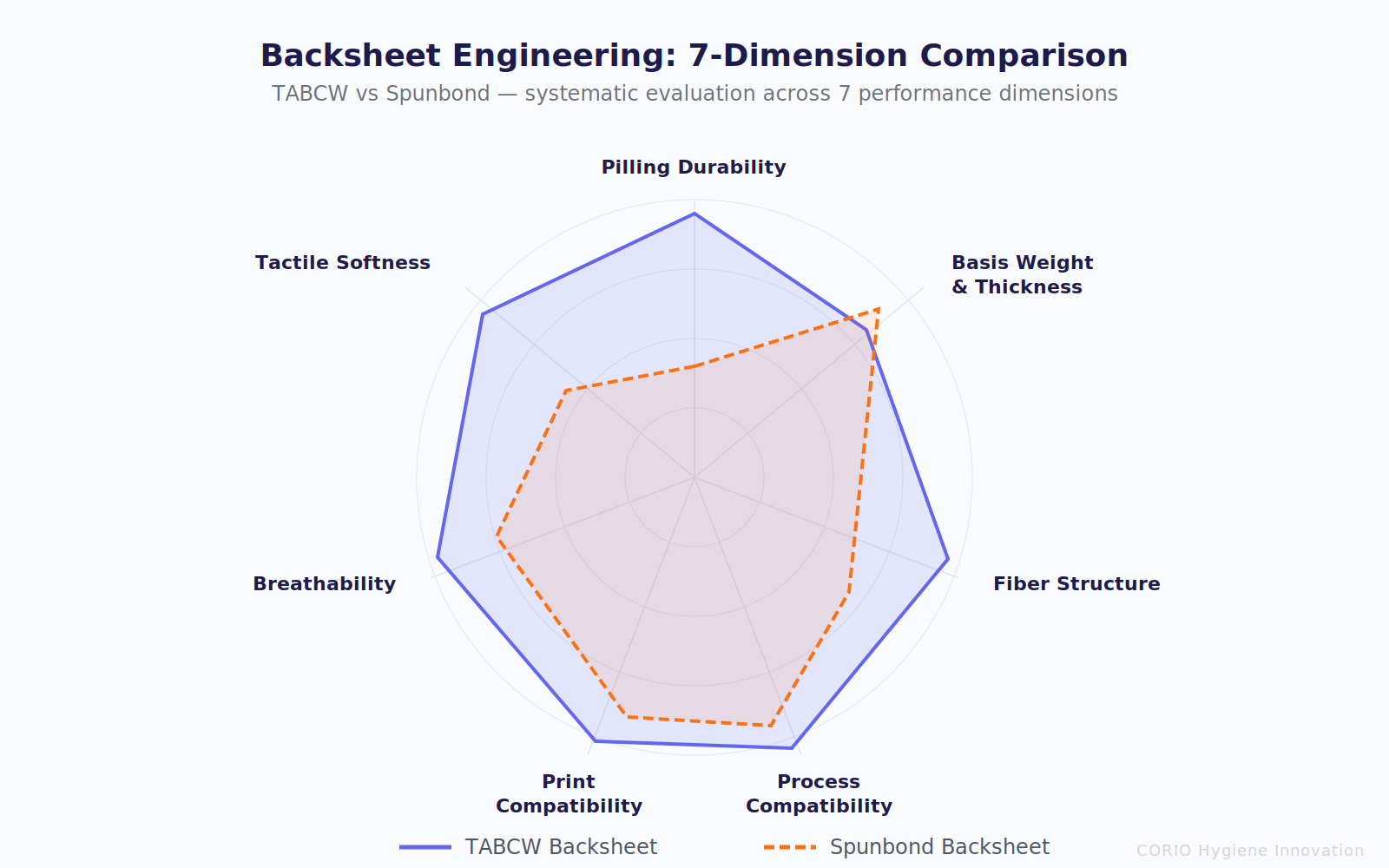
We conducted a systematic 7-dimension comparison between two backsheet technology routes — TABCW (through-air bonded carded web) and spunbond: fiber structure, basis weight and thickness, tactile softness, pilling durability, breathability, print compatibility, and process compatibility with adjacent layers.
The conclusion overturned the initial assumption: pilling is not a manufacturing anomaly but an inherent limitation of spunbond's point-bonding architecture — fibers between thermal bond points are susceptible to surface displacement under repeated wear friction. TABCW locks fibers into a three-dimensional network through hot-air penetration bonding; samples demonstrated significantly higher pilling resistance under repeated wear-friction simulation.
The engineering advantages of TABCW exceeded expectations: it supports high-definition full-color printing, is fully compatible with the client’s selected waistband construction, and its hand-feel is closer to woven fabric than plastic film. This did not just resolve a quality complaint — it opened a new product differentiation dimension.
When the client physically compared the two materials side by side at an industry exhibition, the backsheet direction was locked on-site — this decision was made by touch, not by spreadsheet — validated through calibrated testing benchmarks.